The thread title is a reference to the directions on a GPS navigation app. What direction do we head, up down, left, or right? That is the gist of a story related to me from a friend when riding in a car with a couple of twenty year olds.
I recently was training someone which made me think of that conversation. We were driving trails and good cardinal (north, south, east, west) or locational (toward the pond, toward the shop) was needed. They had none. The drove for Amazon rural, they only understood directions as GPS navigation. It was an additional hurdle to cross with the training but we managed.
Most of us (all?) are older and remember driving without GPS, just paper maps and locational knowledge. If the earliest memory you have of driving was using Mapquest what does that do to your sense of direction of geographic awareness? From my one specific experience it replaces it, or better said, it doesn’t allow it to develop. We can talk about this effect in this thread as I would like more insight on this if anyone has any.
I’ve discussed my views of the effects of marketing on the human mind before so that is related but I am more interested in the issue listed below.
The above got me thinking about AI and particularly how sophisticated online answers to questions have gotten. The manipulation (purposeful and accidental AI) of what is returned to a query and the complete nature of the answers lead me to believe we humans will lose something like we lose something when we rely completely on GPS navigation. I’m not sure what, but it concerns me.
I find myself doing it a lot, where I used to spend time wording and rewording an email, I type out a few half-baked sentences and ask AI to rewrite it for me. As a thought experiment recently, I tried to write out an email w/o AI and it was a lot harder since I became used to using AI as a crutch in this regard.
I started actively not using GPS a few months ago because I was tired of not feeling confident in the directions despite having done similar drives. Even for our long road trip to Canada I only used GPS at the very end near their house, I find it more pleasant to drive without a little computer telling you the by minute ETA, etc.
I played a game once where it asks the group (only mildly) controversial questions and you have to guess how the group will vote. One of the questions was “Does the internet make you smarter or dumber?”
I thought smarter, but someone used this exact example around GPS and it totally made me switch sides. I’ve lived most of my life in a small town and I still use GPS to get around
Earlier today, I was struggling to remember an old movie where the big brain librarians lose their jobs to a computer. I couldn’t remember the title or the actors or even the plot really, so google didn’t work. Thankfully AI had the answer. Phew.
The Economist had a podcast over the weekend about AI and its impact on critical thinking. Arguably AI makes you a little better than whatever level you are, but it potentially degrades your ability to learn and think critically.
Made me wonder if university will return to a more philosophical place, since if the AI always knows the answer to any objective question it becomes much more important to be able to ask good questions.
I often use the Google Map to find the local destination, but I memorize the address and figure out the route myself. I’d rather listen to music and not have it interrupted, ever.
I just turn the voice off - I just use the screen (either from my phone or my car screen, depending on which car I’m driving). I don’t like the voice interrupting things either.
I leave the voice turned off except when driving someplace new / out of my bubble, but I do tend to let Google Maps recommend directions even on familiar routes, since it accounts for traffic.
I can see the differently colored traffic patterns and figure it out myself. My Google Maps does not consider the number of people in the car, so the Carpool Lane traffic (usually a lot lighter, if I’m driving through L.A.) is not considered. And there are times when not driving at all is the option. "Hey, we are having a first birthday party 90 miles from you on the other side of Downtown LA at noon on the 14th! Yeah, no.
Knowledge: Do you know the pythagorean theorem, transitive property of addition, etc?
Skill: Can you actually solve math problems?
Or slightly different but much related: concrete facts vs concepts? Facts are more concrete knowledge, concepts more abstract skill.
AI would see to tilt education more towards concepts and skill.
The problem is that these things are not really separate. Without the skills, the knowledge is meaningless. Without knowledge, the skills are mechanical. Similarly, facts by themselves are empty, and concepts without facts are groundless.
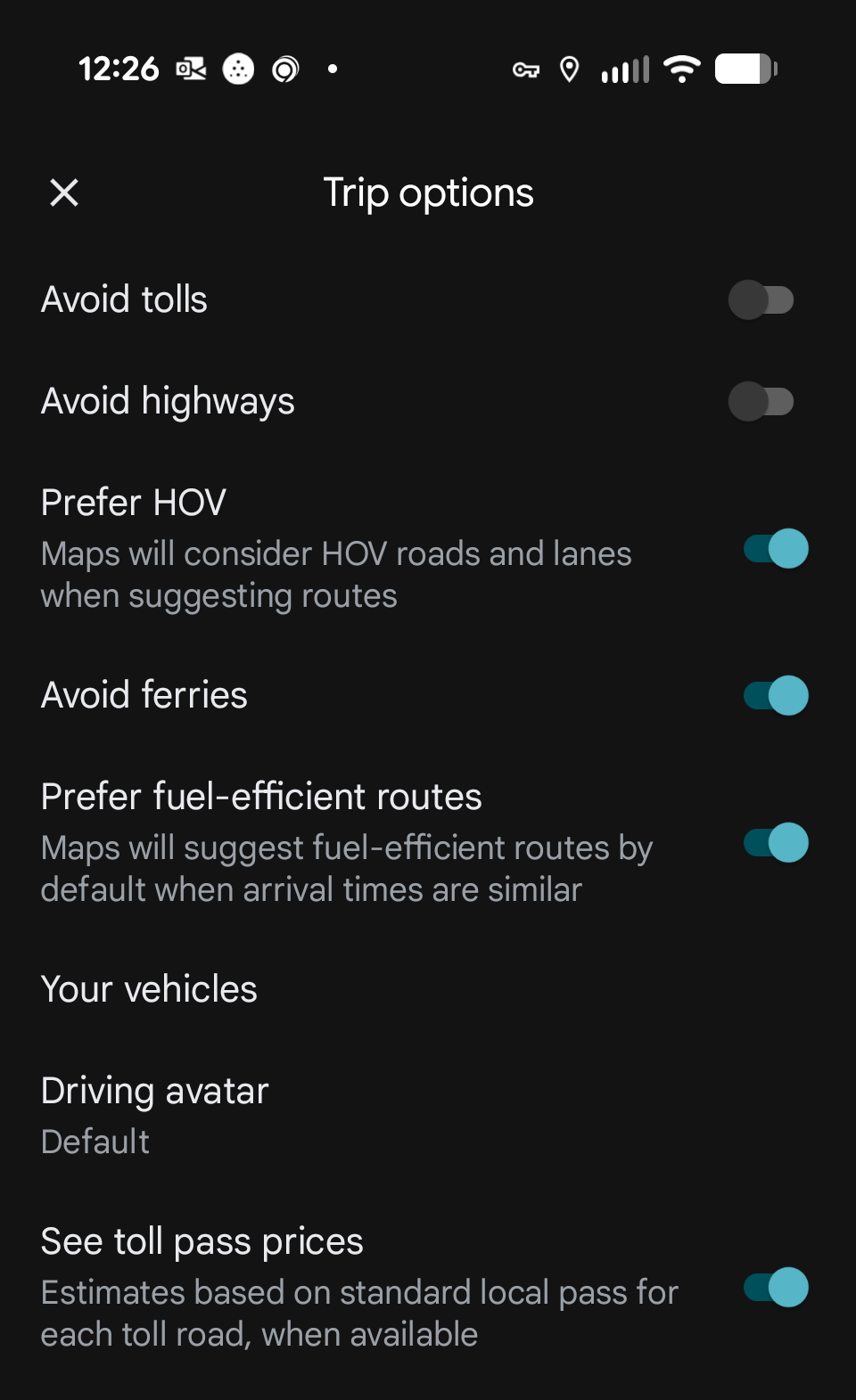
FWIW, I am an active user of the “use HOV lanes” option in Google Maps.
And, while I can see the colored lines and reroute accordingly… my concern is what happens with traffic as conditions evolve once underway. I don’t want to have to study the map while I’m actively driving. I don’t want to have to interact with the phone while in motion AT ALL beyond what I can do by voice.
I do, however, wish that Google Maps had an option for “only reroute if there’s more than an n minute difference”, since I do sometimes take slower-but-easier routes, and I always am left with wondering “is Google telling me to return to the way it wanted me to go because it’s 3 minutes faster, or has a crash just made the way I’d prefer to go impractical”.
After you request directions to a destination, before you tap “Start” , there is a little settings icon that will bring up this screen.
For the most part, you can set it and forget it, but in special circumstances (e.g., you do/don’t have passengers and therefore can/can’t use the HOV lane; or you’re renting a car from MCO, didn’t bring a toll transponder, and therefore want to avoid toll roads), it’s a handy feature.
Actually, in a few weeks, I’ll be taking a trip to see family, and I’ll experiment with the “Avoid tolls” option, because I was surprised at just how much I spent in tolls the last time I did the drive between Hartford and Lancaster, PA.
My dad actively ignores the GPS and sometimes changes his route just to be defiant. That generally worked well when he was younger. Now in his mid-late 70s, it ends up with him and his wife being lost and frustrated as neither of them are particularly computer literate and they struggle to use Google maps and aren’t willing to have someone walk them through it.
I think there should be a setting in google maps to express a tolerance for a more pleasant drive. Sitting in traffic on a highway for 45 minutes might be the quickest but I’d almost always do 50 or even 55 minutes of scenic quiet roads instead. Waze seems the worst with this, trying to shave a few seconds by doing cheeky maneuvers like getting off the highway for 1 exit and back on again.