The reason for this is that you have two major global suppliers of soybeans:
US which is a high-cost producer
Brazil which is a low cost producer
In the past, the global price for soybeans had to be balanced between the US and Brazil, as they were the main exporters with China being the main buyer. US exporters would ask for higher prices (as higher costs) vs Brazilian exporters (as lower costs), so the global soybean price would tend to fall in the middle of that given that China had to buy from both sources as nobody else had enough capacity.
But now that China has effectively blocked US imports, they are buying exclusively from Brazil (who has massively ramped up production), which generally means the global price for soybeans will go down as Brazil is a low cost producer and there are no US exports to bring the global price of soybeans up.
This creates a serious problem for US famers who export most of what they produce.
They now have a serious glut, so they have to get rid of it by lowering prices or getting someone else to buy it. In the past, it was actually the US Govt that bought some of the excess (Trump trashed this by gutting US Aid programs) but now they have no buyer of last resort.
So even if Trump agrees to a deal with China now, that market is not coming back. Brazil will be the winner here as China would see them as more reliable.
So expect a lot of farmers to either go under, get absorbed by larger players, or they manage to change tack and produce something they can export abroad to other countries (which definitely wont be soybeans).
They were flat but low over the past year. They were 60% higher just three years ago though.
However US farmers would have to sell well below the world price to compete for China sales because of the high tariffs China would impose on US soya beans.
Direct subsidies to farmers (a la EU CAP type payments) are basically unsustainable in the US given their debt dyamics and outlook.
They might reduce some of the losses in the short-term, but they will not makeup for the long-term permanent loss of market share that they will be facing due to China blocking imports.
My view is that there will be a lot more consolidation in the US farming space as the larger players (who have the capital buffers to absorb losses) end up buying up the smaller players (who will very likely have to sell given their losses).
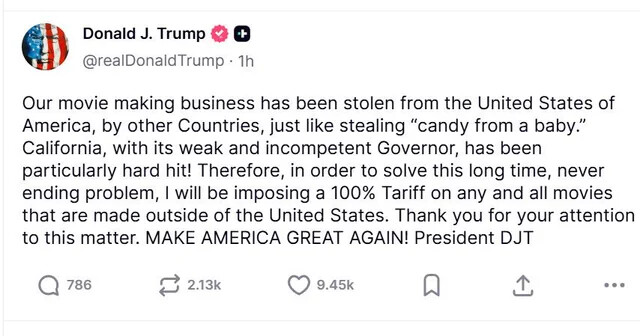
There are 2 questions: 1 - intent; 2 - application.
1 is easy…to prevent foreign depictions of the US from being distributed to Americans; and/or to remove any semblance of actual art/culture. US is best and everything else sucks…I guess.
2 is hard…agree wtf is being tariffed? Distribution channels? Physical movie making equipment? IP of some sort? I’m lost.
The emphasis on movies/entertainment weirdly parallels Inglorious Bastards though.
I kind of think that’s pretty much it. Hollywood accountants are amazing. I’ve heard that Star Wars and Titanic might show a profit any day now…
How do you even value videos of people acting out scenes before you do any editing or special effects? Seems like it might not be worth much more than the cost of the physical media.
Also Trump is “America First” and refuses to provide aid to the starving or to treat disease in third world countries. Billions of aid to a foreigner he likes is no problem though.
Softwood lumber is the Canadian equivalent of American farming. Seems like they’re always getting money from the gov’t, always struggling. I get that it’s a big industry, but at some point maybe they should just tighten their belt.
Or spend that money on developing new products and markets for softwood lumber, other than American new home construction.