Also seems like the leveraged long interest peak had it very wrong.
Looks like when people buy stocks it pushes the price up, and when they sell it drives the price down.
Every month in the US people pump in money into the stock market via their automated 401k contributions.
Until that changes by an appreciable amount (due to an economic downturn) I just don’t see US stocks correcting downwards in a major way.
I’m wondering if the SpaceX ipo will end up being a bit of a bust…
https://www.axios.com/2026/05/21/spacex-ipo-musk-ai
I’m sure the fan boys will be all in, but will everyone else follow?
In the long run it may be OK, but I think it’s pretty well guaranteed that at some point it will look like a bust. If I wanted a piece I would plan on buying after a big lockup expires. For myself I can wait for this or any IPO to get included in mainstream indexes.
That portion of my post only refers to the fact that it isn’t a signal, it’s a fact.
The rebalance seems obvious.
If you are thinking of withdrawal rates..like a 4% rule or some such, it means you can lock in a 5% withdrawal rate for a 30 year horizon. Never lose a cent. That has to be interesting, at least.
And if you are simply looking at asset allocation, and your investment horizon is 30 years, then you may want to reevaluate the risk return on other assets. Investing in equities when interest rates are 3% while you expect a 12% equity returns may make that a good risk return choice. With bond returns at 5%: are you raising your equity return assumption to 14%? That seems a bit off to my eye.
Hasn’t this been true for 25+ years, ever since DB pension plans basically became extinct?
This is a long term trend that might be responsible for higher sustainable p/e ratios compared with earlier decades, but it will also unwind somewhat slowly as boomers transfer wealth to younger generations that may be more likely to spend it, which on its own seems like would only further expand the economy (capital becomes more expensive offset by earnings growth).
1 Like
good question, I’ve wondered this myself as well
db plans also invested pretty heavily in stocks, and db plans have much higher contribution limits than the 401k plans of today
We have had four market stresses in recent years. 1) COVID 2) 2022 inflation 3) Liberation day tariffs and 4) Iran war.
In spite of all of this, we have seen solid earnings growth (somewhat inflation driven), consistent negative consumer sentiments (also inflation driven), and a whole lot of speculation on what AI will do (I think companies are mostly cutting fat staffs and trying to jump on the AI bandwagon).
It’s a weird market where everyone keeps looking for the black swan. Random metrics that in isolation look like doom and gloom when you pair them with some historical correlation. Could all be just a lot of noise for a while longer.
1 Like
Just took a look at the contributions on my db pension plan…
Up to $74,600 my employer and I each contribute 8% of my the equivalent of my salary. Beyond that, it’s 10.58% each. I think for $74,600 and below the difference is covered by Canada Pension Plan contributions and payments from that pension.
Eta: the contribution limit for RRSPs is 18% up to some cap.
An immense amount of new money was pumped into the US Economy due to Covid via QE. A lot of it went into the US stock market.
They have not started tapering that (QE) down. Fed keeps talking about it but does nothing. Thats what has been keeping the proverbial show on the road even with all the crisis that we have had.
But with debt levels pushing 130%, deficit at 6%, inflation heading to 4.5%…and likely rate rises in the horizon, I do think the AI boom would be negatively affected (as it would impact equity prices, disposable incomes, as well as cost of debt for companies). And its the AI Boom that has carried the US stock market in the last year.
You won’t be seeing a huge correction, but we just won’t have the excess equity growth of the last 5Y.
The fed balance sheet peaked at 9T in 2022 and is down to 6.6T currently. That COVID money basically evaporated into inflation at this point.
The debt is unsustainable. Perhaps more inflation is needed. Maybe that is the result of this being unwound through wealth transfers from the boomers to their heirs. They have it all locked up right now.
So the value of the US Stock market is 74T. Small businesses make up 43.5% of GDP. The value of US businesses is some number well over 100T. We have 40T national debt, 20T of private debt, and 6T of local and state debt. Does any of that suggest something is broken? I have no f-ing idea.
Evaporated? I hardly think so. It was spent, no doubt. But it didn’t evaporate. It ended up in the possession of the entities that sold to those that bought. It’s not complicated.
The owners are the high wealth households. You can look it up yourself . The top 10% of wealthiest households own approximately 87% to 93% of all privately held stock in the United States, according to Federal Reserve data.
That is most of the demand right there. Toss in the record setting stock repurchases and. WOW. Stock buy backs are favored by boards a number of reasons. Mostly because it means the gains are unrealized, so those high end net worth households don’t have any taxable income. Then there is the potential value of being able to make acquisitions by using your own stock to purchase another firm. Consolidation is apparent through the US economy.
The PE ratios are simply assuming that those two large demands are not going anywhere, anytime soon. A solid bet imo.
FYI: stock repurchases were not allowed until the deregulation in 1982 under the Reagan administration. I’d throw out any “trends” before that in your time series analysis.
Well, it evaporated in the sense that GDP grew by roughly the COVID money, in nominal dollars.
Did it shift wealth further towards the wealthy? Most of the wage gains happened in the lower-mid percentiles. They did not have much wealth to begin with.
But also, as you noted, its a demand stream paid for by a wage stream. Double prices, double, wages, double earnings, double the stock price. The COVID money was just an incremental piece to all of that.
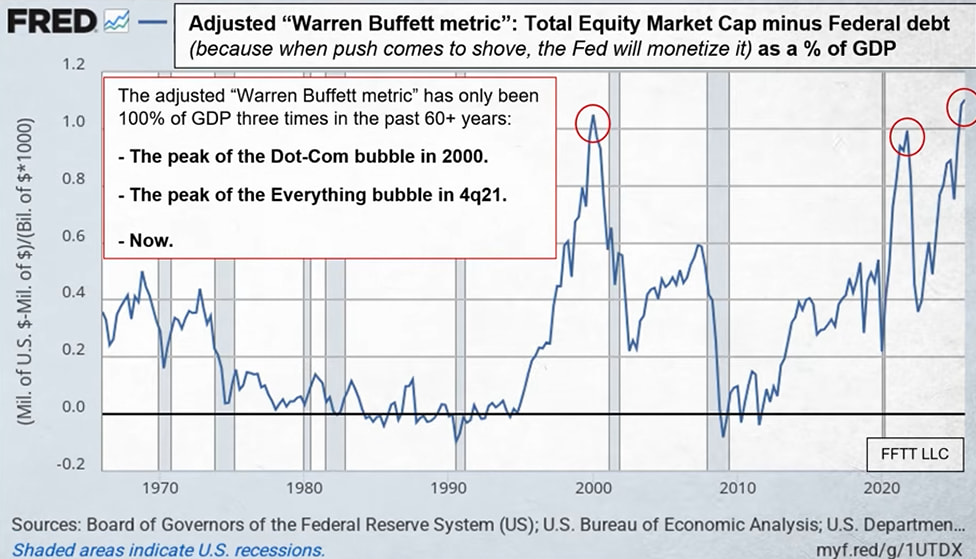
What kind of metrics were available during the robber baron era, and how do we compare to then? Cause that’s kinda what I feel is going on right now.
4 Likes
I’m curious… anyone have any thoughts of Kyla Scanlon and her work?
Who?
1 Like
She seems nice? 
She appeared in my feeds recently, she wrote a finance book a couple of years ago, apparently coined the term “vibesession”, writes articles for a few different organizations, does short videos on various finance related topics. I’m still trying to decide how credible she is. She doesn’t seem to be an investing guru, but does seem to have decent thoughts on the economy. I’m thrown off a bit by her recent appearance in my social media and can’t decide if she’s growing her audience organically or if she’s being promoted.