Furthermore, why does he insist that they don’t exist? He be all like, “Yo Abe, I’m the head honcho here and also, gimmie your son just kidding I wasn’t gonna really go through with that.”
According do this Wikipedia article, not only does Yahweh have a dad, his arch-enemy Baal is actually his brother, and he’s got other siblings too.
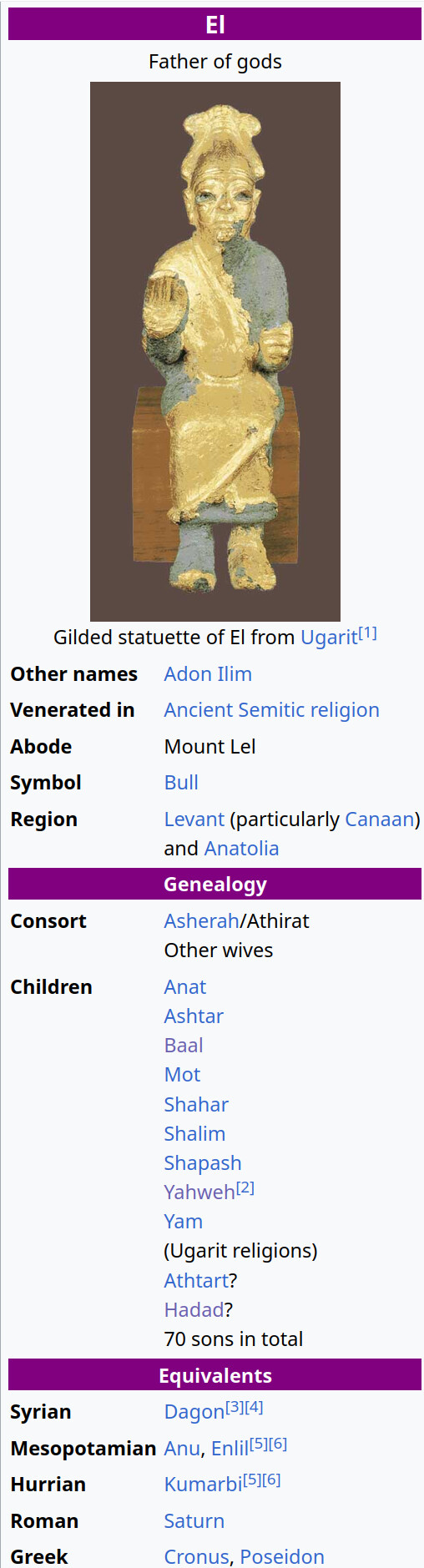
Then he says he’s got a son, but his son is also him, and he’s also his son. I’m not sure what that means but maybe if we help him get back with his family he’ll feel better? 3,000 years might be a blink of an eye, a small family spat perhaps even though it feels like an eternity to us mortals.
Time to patch things up or let them sleep on it for a little longer?

How do we know that El and his 70+ kids didn’t just go on vacation elsewhere in the galaxy and accidentally left little Yahweh at home to fend for himself?
Where do you tie in the info of this picture to being the “Yahweh” of Judiasm?
Note that “Semitic” isn’t necessarily related to solely Jews. Furthermore, that term wasn’t really used for this people group until the 19th century; so trying to use it as a tie to ancient cultures is . . . an improper use of generalization.
Your mom’s an improper use of generalization. Nyah.
I think the term “Semitic” is reasonably being used as a shorthand for the relevant regional + ethnic identities referred to. While there may be more precise terminology, for Wikipedia, it’s close enough.
Anyway, (long time since I’ve been on this forum - years and years and years) I’ve been paying attention to Biblical scholarship for a while now, and it’s my understanding that it’s fairly well established among scholars that Yahweh was just one of a pantheon of patron deities, possibly a conflation of Baal and another storm deity (El? another?). The “one true god of Israel” stuff didn’t really start until around the 7th Century BC, and even then, other gods were acknowledged, they just weren’t as kewl as Yahweh was portrayed. For a long time, it seems Yahweh even had a wife-goddess, Asherah, who was worshipped alongside Yahweh. And that’s why it was so difficult for the various Hebrew kings to get rid of Asherah worship until around the time of King Josiah (most scholars seem to think), who consolidated religious worship to Jerusalem under a single, patriarchal god-head and managed to destroy most of the various Asherah temples in the region.
Even in the New Testament, there’s no outright denial of other gods’ existence. It was still a matter of “our god is the best and the true creator of the universe”. Monotheism as we know it today is a post-biblical innovation.
Um. One of the ten commandments literally has the text " Thou shalt have no other gods before me"
The ten commandments according to tradition were given during the exodus from Egypt, which is put around 1400 BC
There is some dispute around when it was written down; tradition says it was written right away, but there are some who say it was only 700 years later. Seems hard to believe it was that much later though.
So, “family? what family?”
Before I clicked on this, I thought you meant humans were his (her?) family, and God’s been no-contact with us.
I don’t hold with the “traditional” views that the stories in the Pentatuch were “written right away”. In many cultures, oral tradition is given equal weight to understanding a culture and that culture’s history. However, this seems to be ignored when the context is Judeo-Christian culture/history.
FWIW, I do give blame to many of those “traditionalists” that die on the hill of “written right away” and “how I interpret it today is the truth of the message from ‘way-back-when’”.
I think there are many different ways to be monotheistic.
If we imagine the ancient polytheistic religions to mirror human relationships, then worship was patronage, and you picked whatever patron would help you.
So the Romans would steal the gods of conquered cities and bring them back to protect, and be served by, Rome.
A monotheist is one who only has the one patron but may still believe in other gods. This is one reason the Jews had so much trouble under Rome. They couldn’t simply worship the emperor as another patron god.
Even Christian Rome still believed in the old pagan gods, but as fallen angels, that is demons, stealing adoration. Ancient Christians believed they were literally casting out these demons.
Even within polytheism, the identity of gods seems to get weird. For example, Zeus had all these different names and it’s unclear in what sense they were all the same zeus or whether there were many different zeuses.
Over time, Jewish, Christian and Islamic thinkers established such a clear line between the one creator god and his creatures that the word “god” came to mean only the single “God”.
I would say that using the term “written” in our context here is in reference to what do we have access to today. More specifically, what can we use directly to verify history.
FWIW, the Jews really didn’t have that sort of problem. Roman culture venerated “tradition” to a high degree and recognized that Judaism actually predated the founding of Rome. They were actually exempted from the participation in civic rituals toward various Roman deities.
Once the Jewish leaders denounced the “new religion” of those who followed the teachings of Christ, Christians were expected to engage in those civic rituals (since they lost their “protection” from Jewish traditions).
But I agree with the rest of your post regarding the view of “monotheism”.
That is literally an acknowledgement of other gods. It says, “I’m your most important God, you can’t place any other gods first”.
I think the scholarship is pretty clear that the ancient Israelites worshipped multiple gods, of whom the big guy was the most important. And a lot of “Kings” is about the Temple hierarchy trying to put down the worship of other gods and consolidate all worship in the Temple in Jerusalem.