US Federal Debt

I can see that they put a floor on the rate using the IORB. I don’t see how they cap it.

Earlier, I thought you had said they would cut the rate and save money. Maybe I misread something. Are you saying just reduce the maturities of new debt and ride the yield curve down?

I think he’s saying the US has unlimited capacity to issue bills at whatever rate they want and the market will always gobble it up even at very low rates.

That might work until it doesn’t like most leverage.

Fair characterization.my assertion is simply that this fuss over the size of the debt BECAUSE it will burden future Americans is not at all obvious. The Rate is just as important as the notional amount. I haven’t heard anything to refute that basic idea.
The rate can be set by any issuing government that has a fiat monetary system and borrows in its own currency.
The trade off happens on the foreign exchange issue. I haven’t heard any discussion on that front. Peeps are having too much fun with tariffs, and it takes all the O2.
A real world example of my little theoretical is Japan. Check out their vital statistics. Japan problem is more related to an inability to generate inflation, try as the will.
So the burden is not inevitable, it is a choice.

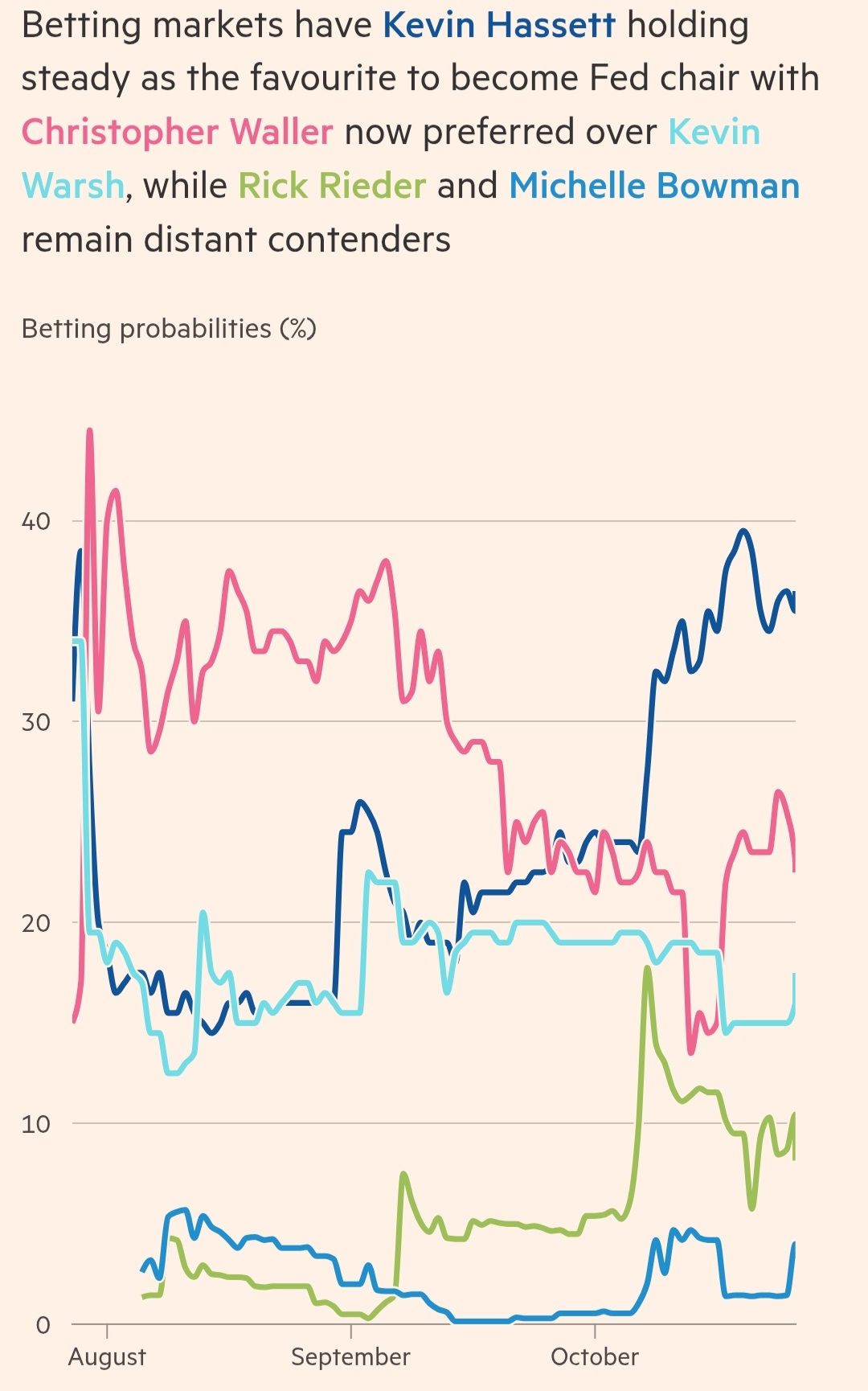
As expected, Hassett is leading:

Now I think you are saying the the federal government can simply choose to issue only 3 month bills and choose the interest it will pay, and investors will buy everything the gov’t offers for sale.

That’s what I don’t get. There is a demand curve for US Treasuries. The Treasury can certainly eliminate auctions and simply sell 3 month bills at a fixed price of 99.5. Some people will pay that because they have a strong desire for US gov’t debt. But, other people who are currently buying, will drop out. They have other options. The Treasury sale “fails” because it can’t sell the volume it wants to sell. The auction system always finds buyers. In my world, fixed prices don’t.

I also see a second problem. The 3 month yield went from virtually zero in Dec 2021 to 5.4% six months later. The Fed engineered that increase because they were worried about inflation and they think the higher interest rates can reduce inflation.

If they have to keep rates low to keep the burden of federal debt service low, then they can’t raise rates to fight inflation. That seems like a problem to me.

That’s quite an assertion. I don’t buy it.
Other than insurance companies and private pensions, I can’t think of any buyers at all. Banks prefer their assets with short duration. Run a bank, you will do the same. The big users of treasuries use them as collateral, just look at the letters in SOFR.

The big buyers are firms that don’t use MTM accounting, either in their assets or their liabilities, or both. They are leery of IR swaps. But these same institutions routinely salivate over high yields in the debt market. They are dangerous. Just look at the public pension situation and tell me things are okay?
Because if you did MTM, you would quickly recognize that all assets earn their short rate in the short term. That’s what the futures market is all about.

If they have to keep rates low to keep the burden of federal debt service low, then they can’t raise rates to fight inflation. That seems like a problem to me.

Low short rates in a high inflation environment invites borrowing short, buying real assets which in turn will lead increased inflation.

Using interest rates to control inflation? That’s a really weak and indirect steering mech, wouldn’t you agree? And even then, it’s the short rate they fiddle with. They can QE or QT to affect the slopes, but they cannot dictate the long end.
There’s no way of compensating for the simple fact that the economic theory underlying that mechanism is based on a false definition of money. It’s not tax and spend. It’s spend and tax. They got the whole thing absolutely backwards.
MMT is simply an accurate description of how money is created. It will take a whole lot more effort to turn MMT into a more generalized macro economic theory. But it sure as hell is an accurate definition of money.

I worked in 1981.

1 Like

I don’t think the US would be able to pull a Volcker this time around.

Okay…that doesn’t prove anything. It’s a Ptolemaic theory.
2500 years ago, the Greeks developed the theory that the Earth was the center of the universe. All celestial bodies revolved around the Earth. They made elaborate calculations that accurately predicted where the Morning Star would appear. Thus proving their theory.. it doesn’t prove the theory, and I certainly don’t want an Ancient Greek in charge of the space program.

I see you have two posts, I’ll try two responses.

I can believe there are some buyers who have uses that really require US Treasury debt, they don’t care about interest rates or maturities. You can provide examples of such buyers. If that’s all the buyers, then the demand curve is a vertical line.

On the supply side, the Treasury is stuck selling the amount they need to fill in the gap between taxes and spending. Since the US Treasury is the only supplier, that makes the supply curve a vertical line. And, since the demand line is vertical, the Treasury can just name it’s price. (The location of that line varies over time, the deficit can increase quite quickly, but the line is vertical at any one time.)

Somehow, the Treasury always sells exactly the amount it wants to sell. That says that the vertical demand line always overlays the vertical supply line.

That seems like a pretty big assertion to me. I don’t see the mechanism that makes that true.

I think that the buyers who must have Treasuries don’t need enough to completely use up the supply. It takes some other buyers, who might like but don’t need Treasuries, to bend the demand line at one end so it crosses the supply line. Those are the people who are currently buying but would drop out with different interest rates (or fewer maturity options).

So if the govt no longer sells long dated instruments, HTH am I gonna create a risk free yield curve? Won’t somebody think of the actuaries?

You will use the swap curve, like most everyone

The mechanism is the rule book. As a primary dealer you have to buy your share of every issue. Your share is determined by your size. I stated this earlier.
Primary dealers derive great access to clientele. It’s like buying clients Super Bowl tickets, i guess.

And Bank reserves can sop up a whole lot. Check it out.

The scale on the right extends to $1.8T. Isn’t that about a year or two’s worth of deficit spending?

I really hate trying to push analogies, but it is so easy to get sucked in. I look at it this way.

Suppose our only interest in planet calculations is to predict the location of the planets as seen from earth. Both P and C have methods for that. They are both “good enough for gov’t work”.

The P method takes more calculations, so we should prefer C. But, suppose we have people who are ready and able to do the P calculations while nobody is stepping up to use C. Therefore, we use P.

So, my story on MMT and inflation goes like this. I recall reading something before covid from an MMT proponent. They said that the real limit on gov’t spending isn’t taxes, but inflation. We can run deficits as long as inflation in okay. If inflation gets too high, simply change fiscal policy and get it under control.

I’m sure I recall the word “simply” in the article I read. That’s because I thought you’ve got to be politically naïve to think that raising taxes or cutting spending is “simple”.

After covid we get inflation. I remember posting (probably here) that the best theoretical gov’t response would be a surtax on FIT with matching changes to withholding. That would rapidly take money out of the economy. We could fine tune the amount in real time.

Raising interest rates was the poorer choice. It’s slower, therefore harder to adjust. Also, I thought the distributional effects of the tax approach were “less bad” than the distributional effects of interest.

But, I didn’t see any MMT proponent step up and say they had the better mousetrap, there was deafening silence from their camp. (If they had said something, it wouldn’t have mattered because the political reality was that tax increases were off the table.)

So, I don’t see MMT helping with inflation today. Until that changes, we are stuck with interest rates. MMT may help with the financial equivalent of the space program, but that’s a different topic.
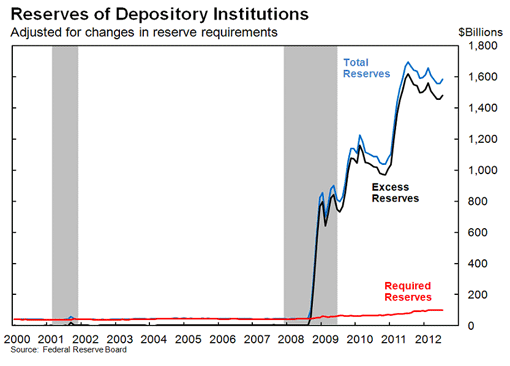
Yep. And I said that if primary dealers take a loss every time they sell to a client, they will decide they don’t want to be primary dealers anymore. If super bowl tickets get too expensive, you don’t buy them.

Yes, bank reserves have gone up sharply. But, $1.6 trillion is very far away from $28 trillion. Bank reserves cover about 6% of the target.

Too bad the “gov’t work” for one of them involved imprisoning those who believed in the other one.

That’s true. It is why MMT exists in the first place: changing tax rates takes too long, and by the time they are enforced, the Economy could have changed.
Politicians needed some way of keeping their jobs. MMT helps that, and it has the bonus of politicians not having to increase taxes, which also affects their job status.

You appear to be interested in eliminating the “Federal Debt”, or at a minimum, reducing it. Before you do, look at the other side of the accounting. Overly simplified to reduce # of words.

The money supply has two primary sources: Government (Central Bank) and private banks.
The Government debt is the money in the economy that was created by the Fed. That money is in private hands now. It is used to buy groceries, pay dentists, and everything else you would associate with the “real economy”. If you happen to run surpluses (Tax Revenue>Spending) and eliminate the debt, then there will be no real econo0my transactions (Except for the money created via private banks). The economy would catastrophic collapse. So lets not target that, please.

To accommodate a growing economy, you can either increase the money supply or increase the velocity.. If you target a 1.5% growth rate, then you should target a growth in MS of 1.5% as well.

Increasing the velocity is less obvious. Now you have to differentiate spending from paying down debts in the private sector. Money used to pay down debts shrinks the balance sheet of private banks but does not get “spent” on dentists and groceries. This slows the velocity…So the key here is how much of the MS is needed to avoid credit defaults.
That risk is pretty much a function of the total amount of private debt. (Right now, its pretty high). So you’ll find people like me advocating for the forgiveness of student loan debts. Young people forming new households buy a lot of shit. Old folks not too much. We need that spending/velocity. That’s the aggregate demand from consumer spending.

If I stopped calling it the National Debt and instead called it the Private Money it might not trigger an emotional reaction. We are taught DEBT is bad, its immoral, get rid of it.Ugh! But s pile of Money for the People..that’s good stuff. Every debt on someone’s ledger is someone else’s asset. Thats how it works.

1 Like