Currently getting absolutely ripped on for not being upset that some store in the local shopping mall is selling posters with AI generated art for $21 each.
AI is harmful to the environment, rips off artists, and is putting artists out of work. However, AI is producing highly derivative artwork, that is unoriginal and copies others. My thought is that if AI is producing unoriginal, highly derivative artwork that is copying others, and it’s eating your lunch as an artist, perhaps that says more about the art you are producing than about AI.
They’d like the government to ban the sale of AI art. I think that’s nuts. I don’t know how you write the law and still leave selling art made on a computer legal. As a photographer, all sorts of very useful tools in lightroom and photoshop involve various flavours of AI. I suspect similar issues would apply to the various paint programs, particularly with fills and such.
Thoughts? Comments?
AI (and its art) is here to stay. Deal with it.
Someone who finds current state AI art appealing enough to display in their home was never going to buy authentic art from an actual artist. They would have bought something mass produced at Target or Walmart that was just as devoid of feeling.
3 Likes
You’ve covered the main points of contention. Are you trying to ban a tool by restricting the sale of its output? If so, where do you draw the line? I understand the nature of the “stolen training data” argument, but shouldn’t that be prosecuted on its own? What if there were an ethically trained AI art machine, would there be a reason to ban it? Certainly the “AI took my job” argument wouldn’t end at artists.
As an actuary, you should be upset… at the price. Shit costs (nearly) nothing to make.
Also, I wouldn’t call it “art.” “Bunch of inanimate objects, rendered by an inanimate object.”
I can understand outrage about the copyright issues. Large corporations got their copyrights extended several times. For example, it was never: if disney loses sales on the mouse, that says more about disney’s creativity as a company than anything else. Superheroes are another good example.
So large corporations win when it’s their intellectual property that needs extra protection. And they win when it’s in their advantage to steamroll over the copyrights of small, independent artists.
I think what makes it harder is that to a lot of artists, AI art is glaringly obvious.
1 Like
Its stupid crap I wouldn’t buy, but tackiness isn’t a strong argument for banning something.
I’m less sure about the claim that AI art isn’t art. I’ve got at least 3 examples where I’m unsure.
1.) If the process is human driven and iterative, it seems to me this is very analogous to a lot of other computer based art. There’s a process to try and refine what finally gets produced and matches the artist’s vision.
2.)Technically speaking, a lot of art produced using a spiralgraph or similar tools is a form of AI. Its maybe not recognized as AI by many, but strictly speaking it is.
3.) Similar to spiralgraphs, I think fractal based artwork is relying on an underlying AI process to generate the artwork.
4.) Wordcloud art. The underlying algorithm is an AI.
5.) If you use generative AI to remove powerless and a few inconveniently located people from your photo, is that photo no longer art? How about if you do a sky replacement or use AI to select the background or foreground so you can use AI to selectively lighten or darken your image?
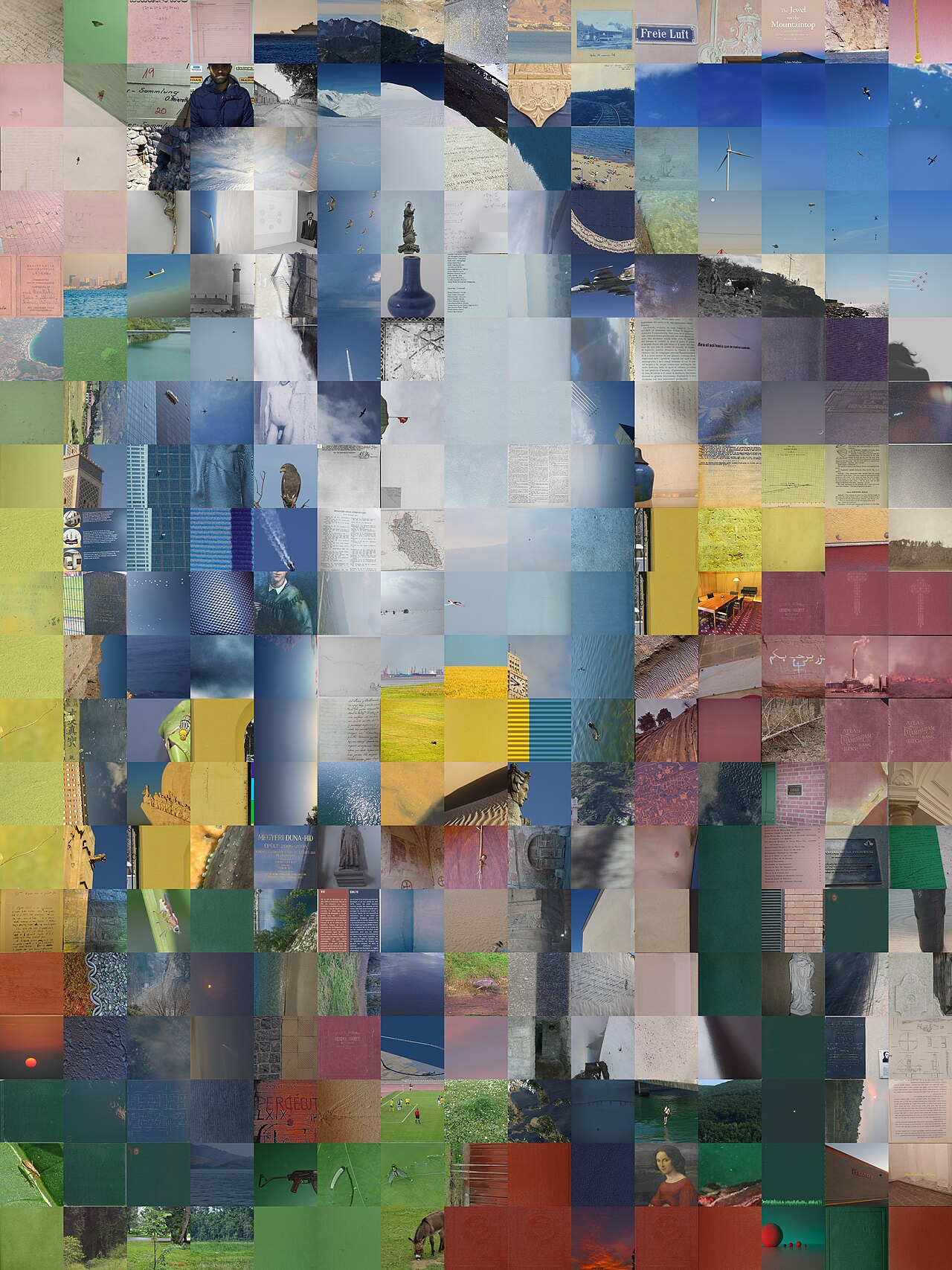
6.)If you’re into collage type art, is it not art if you ask an AI to select images image fragments from a stack of photos and then rearrange them based on some colour scheme to create a new image out of the collection of images using the overall hue of the individual images to help guide the placsment of individual images within your new image? Sort of like this image…
I’m against banning AI art. I think it hurts more than helps.
Yeah, I agree. Way too difficult to do. I probably should have phrased my response in terms of “Does one” as opposed to using “do you” where it might imply I meant “you, Fishie”.
1 Like
There is a big push to refer to these AI models as having agency. You “collaborate” with the model. I think that is nonsense. In the same way, I think an AI model cannot itself create art.
Certainly it can be used as a tool by a human to make art.
I don’t know what the right term is to use.
I routinely fight with AI when it gets stuck in a cycle of giving me stupid solutions.
On the other hand, I also fight with R when it’s doing stupid things.
I agree with you that it’s more of a human driven tool than something automonously creating art. On the other hand it’s pretty good at creating a complete image from some vague instructions.
Need a different friend group?
2 Likes
I also “fight” with mathematical equations on paper.
Ultimately, I’d argue, it’s all writing out and evaluating mathematical equations in different media.
Our intention and values are what imbue it with meaning. The same goes with art.
My problem is when we start imagining the vague concept “intelligence” as a real substance possessed by these machines evaluating mathematical equations. It is no less fantastical than the ancients imagining disembodied intelligences moved the planets, or more recently the cartesians imagining they could prove all of these fantastic necessary truths about the soul and science which Isaac Newton railed against as letting the imagination run wild far beyond experience.
I don’t think banning it is the answer. I would be in favor of required disclosures so people can choose for themselves but haven’t spent any time thinking about how that would work. Similar for Youtube videos… wish there was a way to turn off the AI generated slop
AI art should be no more or less banned than the Photoshopped images that were the internet rage prior to generative AI images being viable.
While there’s a lot of slop out there, and an uncomfortable conflict between copyright and the training of AI tools, I’ve been deriving enjoyment using AI to create images for my own purposes. If someone has the creativity and skill to use AI to create art that can be sold…in principle, I don’t see why that’s not kosher (assuming no fraudulent misrepresentation of what it is).
I do, however, think there needs to be some clarity in the very near future on how copyright works in a world where AI tools are becoming common…and that could have implications on the subject.
Banning is never an answer.
Information regarding the creator of said “art” should be required.
More information is always better.