I heard people over 4-July talking about how great their cars are about correcting the drivers’ mistakes.
I just reply “I know how to drive.”
You want to know what I want a car to do? Prevent the door from banging into the car next to mine. Oh, and for that car to have its door not bang into my car. I’m not asking for much.
The car I’m looking at has in its menu ways to turn off the nanny shit. But, I need to get in one to see just how hazardous the screen is. When I’m driving it, my wife will be handling those duties anyway.
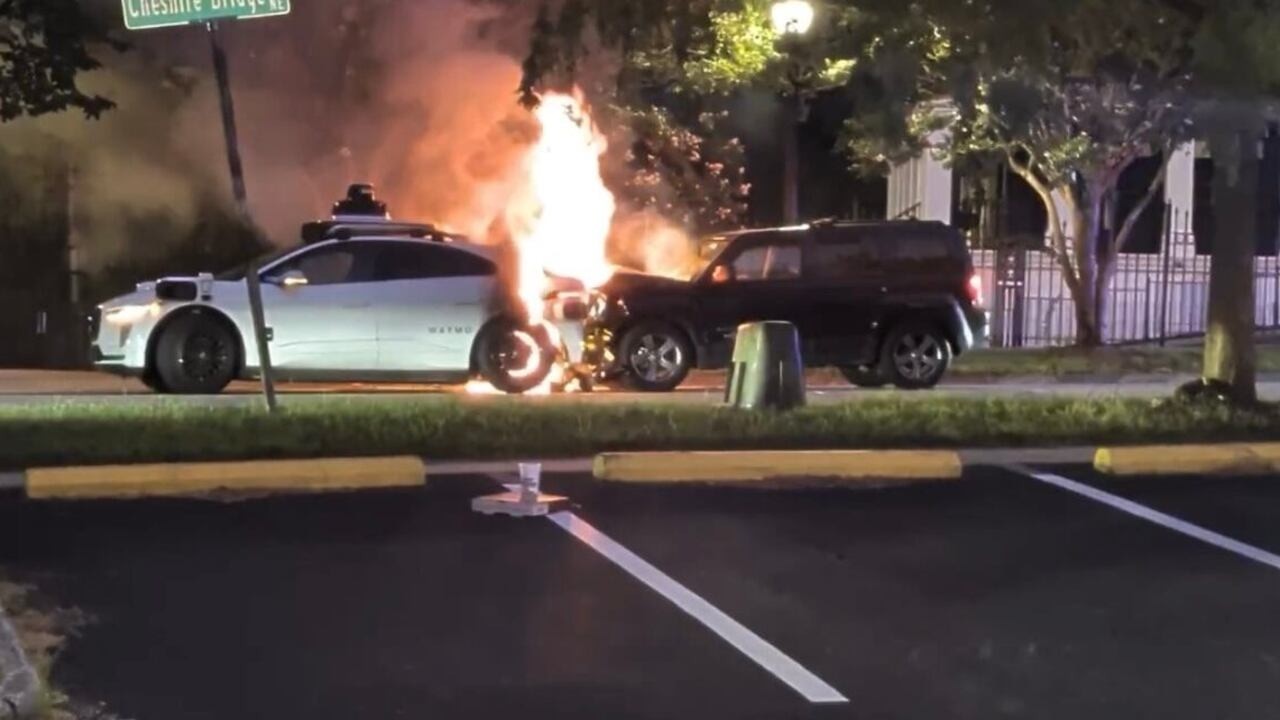
A Waymo got rear ended near my place. The other car caught fire, which then caught the Waymo on fire. Apparently it’s gone viral with morons criticizing Waymo/self driving vehicles. News report link below, which correctly notes Waymos have far fewer accidents than human drivers and this accident was completely the fault of the human.
Interesting logic. So the human caused the accident and some people’s response seems to be that this is proof that humans are better drivers than Waymo.
Edit: Actually it was more along the lines of not trusting AI to drive one safely.
Interesting video of the Tesla FSD mistaking the left solid line of an exit for the right solid line and nearly driving into a ditch at 109 kmph (68 mph).
The last time my friend had his Tesla drive me around, it kinda did that. It stopped as a child’s ball rolled into the street. The child didn’t want to walk in front of a car, so there was a short impass, and then the Tesla decided to run over the ball. My friend stopped it at the last minute.
If my friend weren’t trying to let the Tesla do what it wanted, he would have manually applied the brakes and then gestured to the child like a normal driver.
Before we have a lot of full self driving vehicles in places with pedestrians (you know, everywhere except interstates) we need to have some way for them to communicate with pedestrians. My first plug-in hybrid suffered from being too quiet. I’d be driving through a parking lot, and pedestrians would stand on front of me, chatting, because they didn’t realize i was there. They’d draft out of the way when i drive a noisier ICE. That’s been fixed. My new electric car makes a quiet beep when it’s moving very slowly. But there are other things we say as drivers, like, “go ahead”, that cars can’t do, yet.
(On that same visit, his car played “you go, no you go” with another driver for way too long, because the car misinterpreted the other driver’s intent. Every time she looked around to move into the intersection, the car interpreted that as “looking away” and started to move forward. Incredibly annoying. I’m sure she thought my friend was an asshole.)
I think the bigger issue is to what extent a “theory of mind”, that is being able to imagine other peoples’ motives and future actions, would be needed for a truly autonomous car.
If it is needed, then the only way to get autonomous cars might be to change the environment so it’s no longer needed. What is the cost of doing that?
Interestingly, waymo cars are not fully autonomous (at least last i checked.) there appear to be secret workers helping the cars remotely to some degree.
Waymo (at least claims) they have something like 100 remote workers for 3000 cars. Which is probably fine. I honestly don’t think there’s much value in trying to make a perfectly autonomous car. The exception being if something big happens that confuses a large percent of the cars at the same time, which has occurred with floods and power-outages.
I think simulating ToM is pretty easy-- LLMs do a good job of it. Image recognition of peoples faces and body languages is probably hard. Actual communication is pretty much impossible unless they make the cars speak, which will probably just deeply upset everyone.
There seems to be value in making it appear the car is fully autonomous though.
I think predicting the next word is not at all the same as imagining the actions of a really-existing, flesh-and-blood person, which i think you also say to some degree with your comment on face and body language.
Do you mean for marketing purposes? I don’t think customers care much, but it’s hard to say as there are a lot of other forces at work. If there was a “fully autonomous” competitor we could see which is preferred.
They are selling a particular image of computing based in fiction.
It’s the same reason the term “AI” is used for a collection of fundamentally different technologies and models, and also why these companies are leaning so hard on the idea of a “super intelligent artificial general intelligence” despite there being so much evidence that this is impossible.
I do believe that humans acquire this from extensive observations and learning from others who have had extensive observations and have a knack for communicating the essence of those observations.