I decided if I have any shot of finishing a half marathon next month I need to try some sort of long run. I did 12km on Sunday, but didn’t focus on time. I definitely should have brought some gels/water. Next time.
1 Like
You can finish, just maybe not in the time or shape you would like, nor would enjoy the next day. My worst half-marathon experience was when I wasn’t really trained up, but my daughter (12 or 13 years old) and I signed up. We ran about the first 2 miles then walked the rest. Sure, we finished, but I got a blister an hour and a half in.
When you’re running and you get a blister after an hour and a half, you have like 30 minutes to go and you can tough it out. When you’re walking, and you get the same blister, you have about 2 and a half hours to go, so it’s fucking terrible for a lot longer.
Yeah, I’m not super worried about actually finishing. I know I’ll be slower than my last half marathon so I’ll just focus on running consistently and not burning out in the first 5-10km. I plan to do a few more long runs the next few weeks, upping it to 14 and 16km. If I can do a 16km run before the race, then I’m pretty confident I can struggle through another 5km when needed.
I also didn’t enjoy the next day after my first half marathon so I’m not worried there.
While I didn’t to finish my casual half marathon, I definitely COULD have walked the last two miles, maybe with some trudging jogging mixed in.
Which made me wonder about how much harder it is to add mileage after you get to a certain point. Like, I imagine if I could run 20 miles, I could probably run 26.2. And I knew I could run 7 miles, so I feel confident that I could run 9 if I had to. But I could not just add 6 miles to 7. Is there a rule of thumb for this among runners? Like you can run generally x% longer in a race than your longest casual run? Or is it more linked to the distance you can already run? Like if you can run 50 miles, training to run 100 would be “easier” than if you can only run 13 and want to train for a full marathon?
Funny you mention that, because the 20 mile mark is where runners often “hit the wall”. This is due to depleted glycogen stores. For distances over 20 miles, most runners need to consume nutrients during the race to avoid it. This may take a little getting used to because eating/sucking on a gel during a run feels weird at first.
1 Like
My anecdotal evidence says it’s questionable at best. Depends on your definition of ‘run’ I guess. When I ran a marathon the first 20 miles went pretty smoothly. Got a weird cramp in my foot about mile 16 but was running through it ok. After about mile 20 I struggled mightily. Had been on a 3:40 pace, ended up about 4:05.
1 Like
Most programs increase the long training run by 1 or 2 miles a week, culminating in a final long run 2-3 weeks before the race that is still 2-4 miles short of the actual goal. My first training for a half-marathon we did our longest run at 12 miles. Most of my training since then has maxed out at about 11 or 12.
One thing I’ve seen for training amateurs for long distances is to run the amount of time your long-distance race will take, but do it at a slower pace so that you don’t get so many miles and, consequently, quite so depleted. Like, if you’re going to run a 26.2 mile marathon, run 20 or 21 miles in the same amount of time that you expect that marathon to take. Same for a half-marathon: run 10 miles in the amount of time your are targeting for the finish.
The reasoning behind this is you get your cardiovascular and digestive systems accustomed to the amount of time, if not exactly the effort, that you will need to support on the day. And energy, more so than joint pain or blisters, as others have said, seems to be the limiting factor for most who struggle at the end. I often take a gel when I’m going to be out for 70 minutes or more. 60 I can do without one, 70 I’ll take the gel about 35 minutes in. Definitely an acquired skill, so if you have a chance to practice a few runs with one before a race, do it.
2 Likes
The gel advice seems solid. I usually will run 10km/an hour-ish without gels. I extended my run to 12km and those last few kms were rough.
I’m to big to do anything other than run walk.Best case I do 10/1 run/walk. I can’t run the whole way, my heart rate isn’t sustainaible.
I’ve run/walked a number of half’s and I’m quite happy with the idea that I’ve completed them all :).
2 Likes
you can more or less double any single digit distance for “able to complete X in one piece means that I could likely finish 2X without dying” (but feeling great isn’t promised).
there’s a huge gap someone mentioned about getting past ~20 miles. you run out of energy that is easily accessed and so you could “bonk”.
the 50 to 100 is probably easier than 13 to 26 bc training for 50 means you already have planned for many hrs on the move, can replenish fluids AND food calories while moving. just do it for longer. but once you are running a 30 miles on a saturday training for the 50 you are doing (and including running on a stomach w food in it)…no limit.
1 Like
I did the first day of the 5k to 10k program today. It was more humid (for the Pacific Northwest) than I thought, so it was less pleasant than I expected. I have no desire to actually compete in a 10k event, but figured it’d be good for exercise and help improve my 5k time.
2 Likes
An older former running friend (former runner, current friend, age 70) once told me that back in the 1970’s or so there used to be a rule of thumb that you could finish a race 3x the distance you regularly run. Or maybe it was the distance you can run daily.
When I ran my first half marathons I was running 6.5-7 miles every day. I never ran farther than that. I had no problem finishing my first few half marathons in the 1:50 to 1:55 range. I think that longer distances like full marathons or ultra marathons are probably different but I never tested it.
1 Like
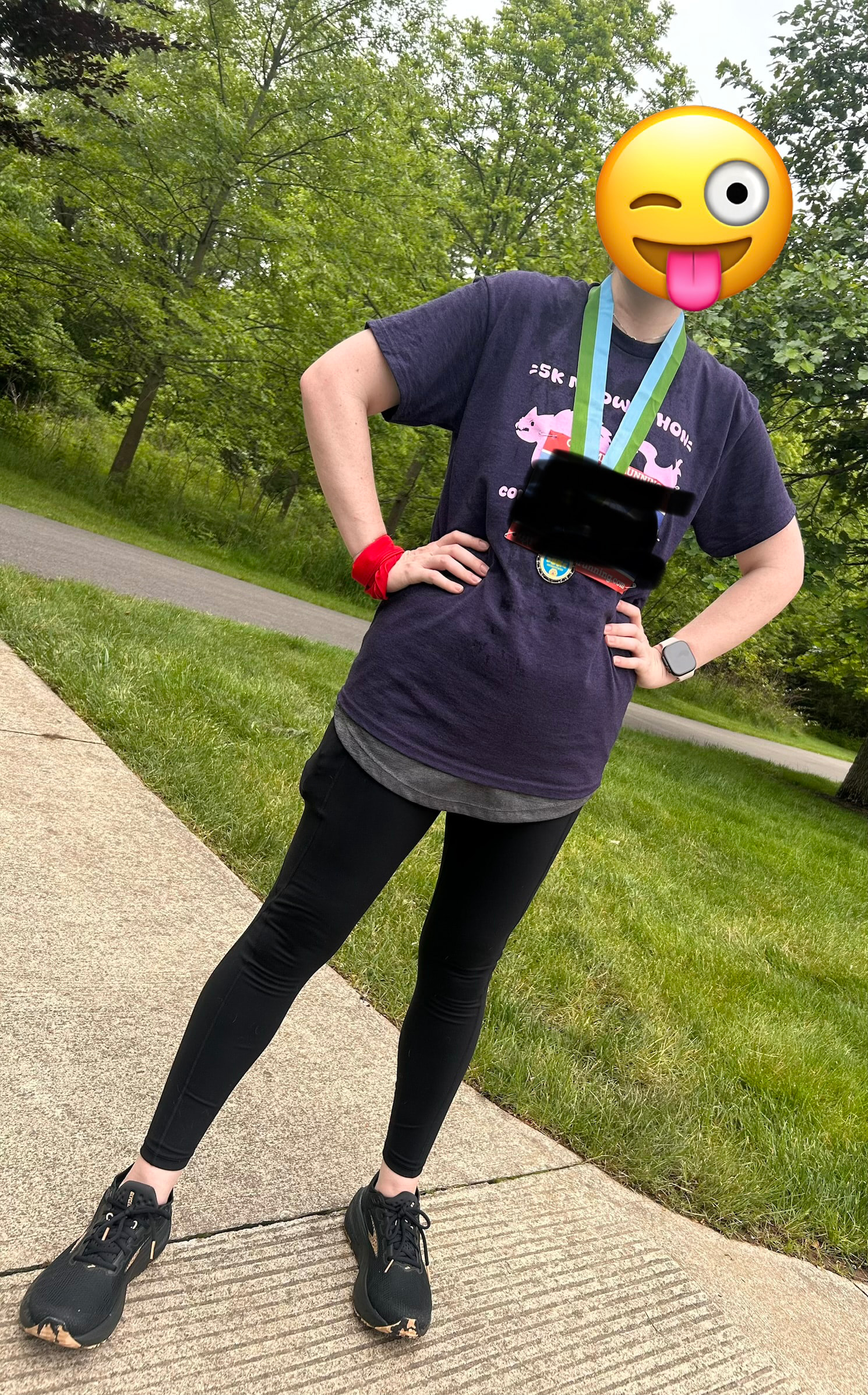
31:41 time today, which is 25 seconds faster than my previous race. Which my watch tells me was only 3.07 miles, so probably really about 40 seconds faster.
I felt really crappy from the start, so I’m a little surprised by the result. I was dry heaving after I finished, but no vomiting today!
(My watch says I did it in 31:33, which I’m inclined to claim.)
11 Likes
Ran another 5k leisurely after I got home, because I wanted to get at least 6.5 miles today in total. 34:40. About an hour break in between. Maybe I COULD run a 10k in under 1:08 by November.
4 Likes
I think I’m finally recovered. Did 6 miles on the flat gravel trail today, alternating half-miles between about 10:30 and 11:30, focusing on form and keeping consistent during those half-mile segments of increased speed.
It’s time to re-plan for the next few months and set some goals. I want to do another half-marathon this fall with my friend, I’d love to get that down to about 11:00 / mile, so ending around 2:24, which would be 6 minutes faster than last fall. I feel like I can do it.
Also would like to get my 5k pace down to about 9:30 / mile, but that might be a 2-year goal. Perhaps this fall is just getting it back under 30 minutes total.
3 Likes
Anyone use this? Looks like a fun concept - you capture territories based on running a loop. I’m not in a great area for it (lack of contiguous neighborhoods) though.
That may be just enough to get me out of running retirement. Though I don’t own a GPS/watch…
Does a phone also work? Or do you not take a phone with you on a run?