
I think care should be exercised when discussing “solar power” and use of batteries . . . it’s not as simple as just charging a battery for use when the sun doesn’t shine.
Yes, you can have a battery supplement electrical supply during non-sun periods, but how long will it take to charge that battery given the output of the solar panels and the demand for that output relative to how much can the battery store during that time period and what the demand is for that reserve power when the solar panels aren’t producing.
Sure that’s a question about efficiency and capacity not about solar being able to supply power when the sun is down through stored electricity in batteries.
It would be an argument for needing alternatives to meet the demand that solar can’t meet.
But I don’t see the humor in that.
And I guess techincaly the d-bags comment about not producing electricity when the sun is down is actually accurate if intentionally misleading.
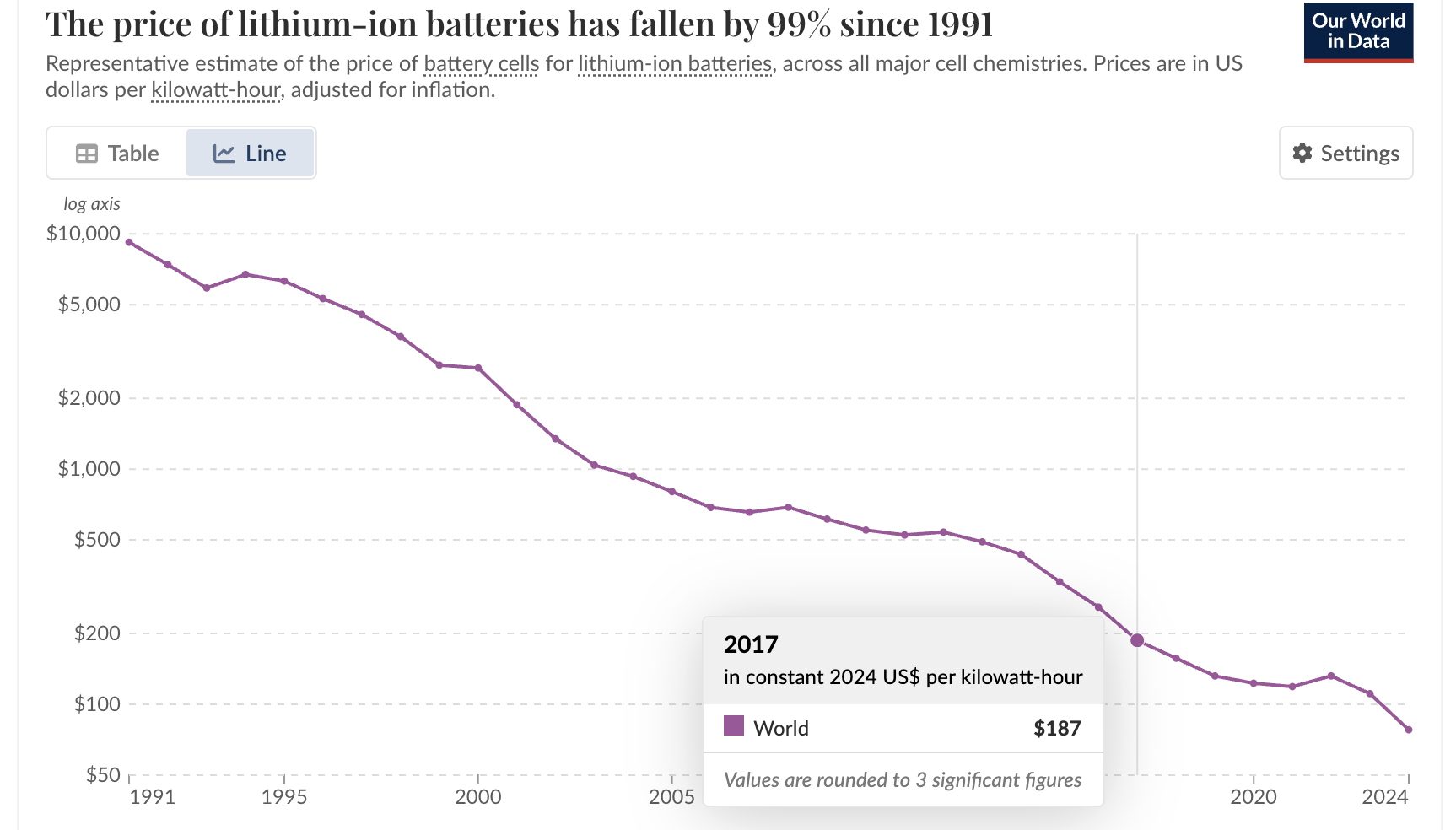
Battery prices have fallen significantly and for stationary batteries even more so, where space is not the issue compared to usage for EVs. CATL has announced a sodium-ion battery priced at $19/kwh. That’s about 1/10 of what batteries cost in 2017. So not having enough battery storage is becoming less and less of a problem.
Not your fault. It wasn’t all that funny.
It would be funny if solar panels were actually batteries. but they’re not. batteries are an additional $10K or so.
There are also some other things that could be worked in here. In many places, like Texas, or here in Kansas, the grid is strained only during the summer. When it is hot and sunny, so solar is a good match to cover the peaks.
And then you have wind, my electric rates are super cheap overnight, when there is still a good amount of wind generation but demand is quite low. Some of that could be used to charge up the batteries.
I am not an engineer, are there still times when it’s cloudy and the wind isn’t blowing much, and if that goes on too long would the batteries run out? I can’t imagine that utilities haven’t done this math.
I have read that solar will still charge (but at slower rates, around 10-25% of sunny days) from reflected light on cloudy days, even in winter. One thing that will stop the charging during the day is if they get covered with snow.
Currently there are around 30 million acres dedicated to growing corn for ethanol. To power the entire US with solar requires (if my math is correct) 6.4 million acres (one website says 13 million). That’s for our electricity alone, so not sure how much extra is needed for transportation.
I’m pretty sure the current answer is natural gas for backup power.
Pretty much this. Calculations would have to include the start-up time and costs to turn a gas generator on. Probably longer than my personal gasoline generator which is loud as hell the one time (so far) that I had to use it (planned outage).
An EV battery would be a lot easier. It would depend on how far you would need to drive to charge up the EV though.
Googled this thinking maybe this was still kind of pie in the sky. Looks like it’s a little further along, lol.
https://electrek.co/2026/04/27/catl-sodium-ion-battery-60gwh-energy-storage-deal/
For what? Running the house electricity?
Most new EVs have the capacity (although some are still waiting for it to be turned on) for V2H (Vehicle to Home). EVs have been used for power during outages. An average EV battery could power a home for two-three days and much longer if only the fridge and electronics are kept on.
That would mean not being able to use the car, right?
Funny, they include apartments, not considering where the car is parked relative to the apartment or the electricity input.

Not for extended periods of time unless you have some form of energy storage at home. Ideally you would have some amount of storage that would allow you to take the vehicle out for a few hours (and perhaps fully recharge while you’re out and about).
Apparently your fridge is OK for up to 4 hours (freezer longer) without power, so you may be able to go out for shorter trips even without energy storage.

They already do this. Natural gas is the flexible source in today’s grid. The EIA says
Nearly all natural gas-fired power plants are dispatchable, meaning that they can reliably be called on to meet power demand when needed by the grid.

That belongs in Truths