I look at Canada’s purchase of military fighter jets. We’re getting pressured to buy F-35s, but they seem useless for defending Canada against its most likely invader, the US. The operating system is owned by the US, which is problem 1. Problem 2 is they require complex and extensive maintenance with highly specialized equipment. The alternative we’re considering from Saab, appears to be vastly more repairable and could be operated from remote, opportunistic airfields. As Iran showed, if you blow up 1 or 2 logistics hubs, you can quickly hobble the US military given the complexity of their equipment. The F-35 is clearly a more capable fighter. However, its useless if you can blow up their maintenance facility. Whereas it seems like you can operate Saab fighter jets from some barns and quonsets in remote locations.
Ultimately, these two both answer to the voters, and its the voters that are green lighting the current state.
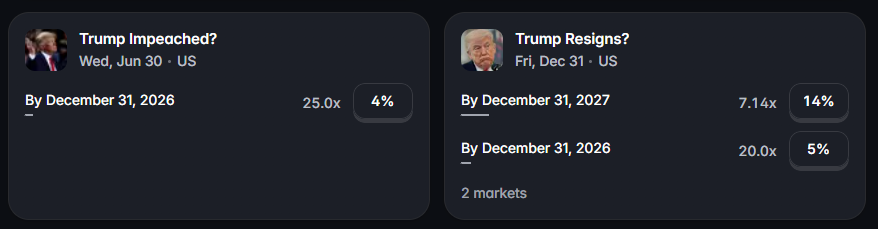
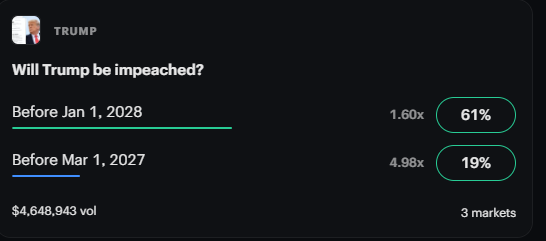
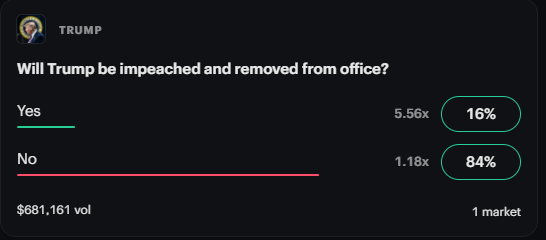
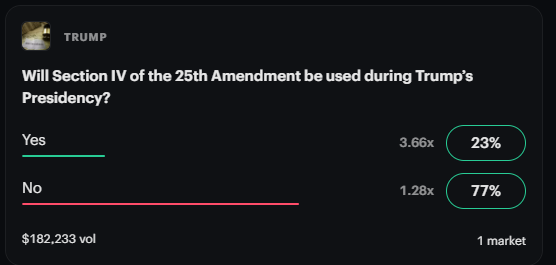
The remedy for the situation is impeachment. The US constitution has a very high bar on this with the 2/3 required for support.
I wonder if impeachment could have been successful after something like January 6, if Trump was not leaving office in 2 weeks anyway. We prioritized moving forward.
But ultimately the question on this is, given everything we know, should we start removing Trump and other leaders? The constitution is intentionally slow moving - this is part of the design. Self corrections happen every two years. We are about to have one. Two years feels like a long time when you are in the middle of it. Two years is not a long time in history.
Trump is also approaching a 33% approval rating. Impeachment is becoming realistic. It won’t happen tomorrow, but he’s getting desperate, yet feels invincible with immunity. This sets up a fairly high probability he does something that will really piss off the collective voter.
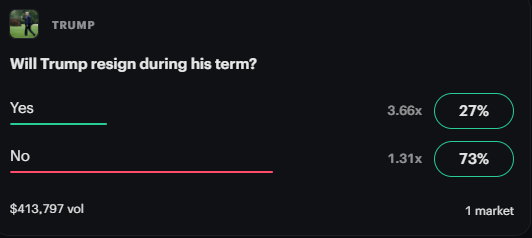
If that were to happen, we would quickly forget about the path to get here, and remark how great the constitution is. If he quietly disappears over the next two years after a big loss this fall - the constitution will have held.
…and that gets at why I’ve adopted the stance of just sitting back and watching it all burn.
The Constitution had worked because the various parts of the government and the public in general were willing to do their part…to a sufficient extent, anyway…to make the country work.
However, the Constitution lacks an effective safety valve for what happens when the relevant parties aren’t willing to do their part.
Yes, the safety valve is supposed to be the next election, but 2-4 years is a much longer time today than it was in the late 18th century, and the architecture of our elections system have made the will of the voters increasingly irrelevant to the operations of the country.
Unfortunately, in an environment where the political architecture has severely constrained the relevance of voters’ opinion in the government, achieving a conviction after impeachment is something that is impossible unless/until the Glorious Geezer does something so dramatic as to shatter the spell keeping his personality cult together.
Now, it should be noted that I think there is wisdom to having a buffer between the voters and the actual operation of the country. There does need to be some stability for a government to have any hope of doing its job. Designing the political system to be immediately responsive to the whims of the mob of its citizenry is a recipe for disaster.
Elections that serve as sufficiently accurate representations of the will of the governed are clearly the preferred way to remove misbehaving politicians from office, with impeachment and the equivalent mechanism for the House/Senate reserved for exceptional cases.
The problem I perceive is that the Constitution lacks the architecture to provide for elections being “sufficiently accurate representations of the will of the governed”, or to provide adequate checks when a sufficient portion of the government chooses to ignore the spirit of the Constitution.
If we are debating the wisdom of our constitution, I have to imagine a parliamentary alternative. If we had a one house legislature that could hold a no-confidence vote at any time, would we be in a better place?
There are all sorts of things that intentionally enable the less than 50% threshold to be represented. If we can accept this can also apply to how we elect people (currently, 47-48% is sufficient for POTUS?), then what?
It’s a shorter term trend, all things will revert to the mean. Can’t wait for Texas to tip blue one day, and then we will see how long things go the other way.
This feels possible, at least he has become vulnerable. He will be full lame duck soon, and disposable to the GOP, and he is pissing them off by keeping all their campaign money. Without enough popularity to matter, he will become irrelevant, and possibly disposable.
His arrogance will keep the risk high that he does something stupid enough to tip the scales.
While I think the no-confidence mechanism of a Westminster-style parliament would provide the safety valve of being able to force a change in direction without waiting for the next election…well, would there have been a no-confidence vote in a world where Trump were PM and the GOP controlled parliament?
There are pros and cons both ways when comparing American-style architecture to UK-inspired architecture. I think the redeeming aspect of the American system, at least from the perspective of someone raised with the myths of the American origin story, and of someone with libertarian-ish tendencies, is having a division of power between the legislative and executive branches, with each branch acting as a check on the other.
My current thinking is that I’d like to see the judicial branch a little less constrained on when it can/must be involved. SCOTUS has used standing as the basis to avoid intervening in some of Trump’s agenda. In a trifecta situation, there is essentially no one able to act as a check on the party in power in between elections. That needs to be addressed somehow, although whatever mechanism is used shouldn’t be too easy to invoke.
I’ve also wondered whether the constitutional prohibition against judicial advisory opinions ought to be revisited. It should also be acknowledged that if the judiciary gained power through reforms along those lines, there would probably need to be some effective check on that power.
I’d attribute it to a broader risk given the architecture of how we select legislators and generally conduct elections. Gerrymandering is certainly an extremely visible manifestation of that risk, but I keep coming back to various issues that arise from relying on FPTP elections and representation through single-legislator geography-based districts.
I also think the US doesn’t do itself any favors with its relative lack of rules regarding the conduct and funding of election campaigns, although addressing that while respecting freedom of speech/expression would be a very tricky tightrope act.
I don’t think Trump will be as impotent in his lame duck period as other presidents have been. While the GOP needs to start pivoting towards a post-Trump reality, and while the power of Trump’s personality cult should erode once he’s out of office (failing someone suitably charismatic with compatible politics coming along)…they will be a force to be reckoned with through at least the 2028 Congressional primaries.
You’ve got to have a few demonstrations of the Trump personality cult not being relevant in GOP primaries before sufficient GOP legislators will be willing to break ranks.
When discussing how things might be different in the US if the US had a Westminster-style parliament instead of the White House+Congress strucutre…I’m thinking there might need to be a few layers pulled back and considered.
I’m working from the hypothesis that a significant part of the reason Trump holds so much power is fallout from his personality cult. Not only can the cult vote in like-minded legislators, but the threat of being primaried and the awareness of the availability of a material block of votes provides an incentive for some legislators to go along with Trump’s directives, in order to protect their position.
In countries with Westminster-style parliaments, the concern of being primaried doesn’t exist.
I don’t think the UK, Canada, etc. are immune from the risk of being taken over by a leader with a personality cult, but it’s probably harder for such an individual to gain such control.
Westminster-style parliaments as they are currently implemented don’t fix the issue I have with single-representative legislative districts, but the population of ridings/constituencies is small enough to make that probably less of a concern than it is in the US today.
I do still suffer from indoctrination from US schools biasing me against the notion of concentrating so much power in a single government body, however. Maybe real-world experience shows that that is more paranoia on my part than a legitimate concern…but then again, the US system wasn’t excessively broken until it failed spectacularly in the past 20 months.
I think the realization that things can easily get (from my view) f’ed up is not going to easily be forgotten - especially by the Republicans, unfortunately. I think the Trump administration is no longer a horrible Constitutional anomaly, it’s a blueprint.