Lol
2 Likes
Somewhat similar to the housing market in Australia. A young person would go into a bank to get a loan to make their first home purchase. They have a certain house in mind but the bank says to them “you know with your salary (and our wildly overoptimistic prediction on how it will improve) you could afford a house twice as much”.
So, many people don’t buy the house they need, they buy the house to the maximum of what they could “afford”. That’s one reason why Australians now have the biggest average sized houses in the world.
1 Like
There was a thread on the AO about an article that listed “most desirable status symbols” that the posters were ridiculing because it contained things like iPads and iPhones.
I guess to some people, somewhere, it’s a big deal. But to most actuaries it’s like, uhhh, I guess I can buy one but why?
1 Like
The Taiwanese guy was right though, bics suck. I’m not a fan of Parker pens either though.
2 Likes
I’d like an affordable car if anyone is selling.
I’m currently driving a 2005, but that’s only because my other 2005 gave out on me.
1 Like
when my minivan failed last fall, I bought a 2008 Honda Accord with 160k miles on it for $5,700.
1 Like
Status symbols aren’t very interesting when they can be easily afforded.
1 Like
When it comes to older cars though, the expected maintenance costs may make them comparatively unaffordable. It appears that the Honda Accord has lower than average maintenance costs, but they only say up to 10 years.
I didn’t use one. But, I didn’t use any kind of ballpoint. I used a fountain pen that had an internal plastic cartridge filled with liquid ink. I was a math student doing proofs and the fine nib on the fountain pen let me make tiny subscripts and superscripts. Occasionally, the ink leaked.
This is before anyone was selling fine-point gel pens.
(I did have a Timex watch and my partner had a nicer name brand.)
My car that died was an accord. It made me very sad. This is the first time it has given me any problems, but the problem it has would just cost way too much to fix.
Some of the best evidence to confirm the thread title is America’s obsession over SUVs. A minivan is going to be functionally superior in nearly every way over large SUVs for much less, with better mileage and lower maintenance costs. But they aren’t cool.
3 Likes
But my minivan has a sticker of Grogu on one of the windows, doesn’t that make it cool?
And the parents of one of the other band kids drive an Odyssey with a bumper sticker that says “My Other Car is an Iliad” which makes me chuckle every time I’m behind it in the pickup line.
5 Likes
I’m not sure if Star Trek was ever cool, but I kind of liked some of the minivans and harchbacks back in the late-90s because they kind of looked like the shuttlecraft on Star Trek…
For the entry level buyer, like a kid or someone making 40k a year or less, there really are no suitable new car options today.
Really, I’ve been looking at options recently. I don’t want to spend over 25k and I want a comfortable SUV with good reliability. In that range I find 10 year old vehicles with at least 50k miles. I just as soon keep my 20 year old RX350 going a while longer.
1 Like
Cheap cars still exist, but they just come with an extra 15% in standard features, and are generally nicer cars that will last longer.
Everyone i went to college with drove POSs. I think our expectations have changed somewhat as well.
How about a Hyundai Venue with a $22,200 sticker including freight? Build Your Own Hyundai | Trim Selector | Hyundai USA
5 year warranty with 10 years on the power train.
But, I agree that companies could build cheaper cars. The cheapest Venue comes with air conditioning, automatic transmission, power windows, and power locks. My first new car didn’t have any of them.
2 Likes
I believe the issue with a lot of those “options” is that available market for them is so small that it would actually increase costs to have a production line that could handle both the manual and automatic options. The price for window motors and lock actuators is a fraction of what you would pay as an option. Making it a standard feature simplfies production and should in theory pass some of the total savings to all buyers. Car makers are far from killing it in profits these days - its a competitive market.
2 Likes
Sure, options turn into standard equipment because the overwhelming majority of buyers take the option. The company theoretically does the math. What is the expense of the manufacturing/marketing complexity of not putting X into the standard model? What happens to the price if we try to recover that cost from the small minority who currently don’t buy X? Does that decrease the price gap to the point that those currently opting out would opt in?
That’s my point. The reason simpler cars aren’t available is that Americans won’t buy them, not because manufacturers would refuse to sell them.
Re-reading that post, I could have worded it better. I should have said “Companies can and would produce cheaper cars if they believed people would buy them”.
Tangent: Somewhere, some Chevy/Buick dealer started saving the glossy sales brochures back in the 1950s. When his son took over the dealership, he inherited the boxes of brochures and just kept adding to it. And so on. I’d enjoy looking at the brochures just for old time memories.
I’d also like to track the features as they became available. First as options on the top models, then worked their way into standard equipment. Then, get the old auto magazines that have more detail like when the 2 speed automatics became 3 speeds, then lock-up high gears, etc.
I think it would be a very impressive chart. Of course, someone may have already done it and the results are on the internet if I took time to look.
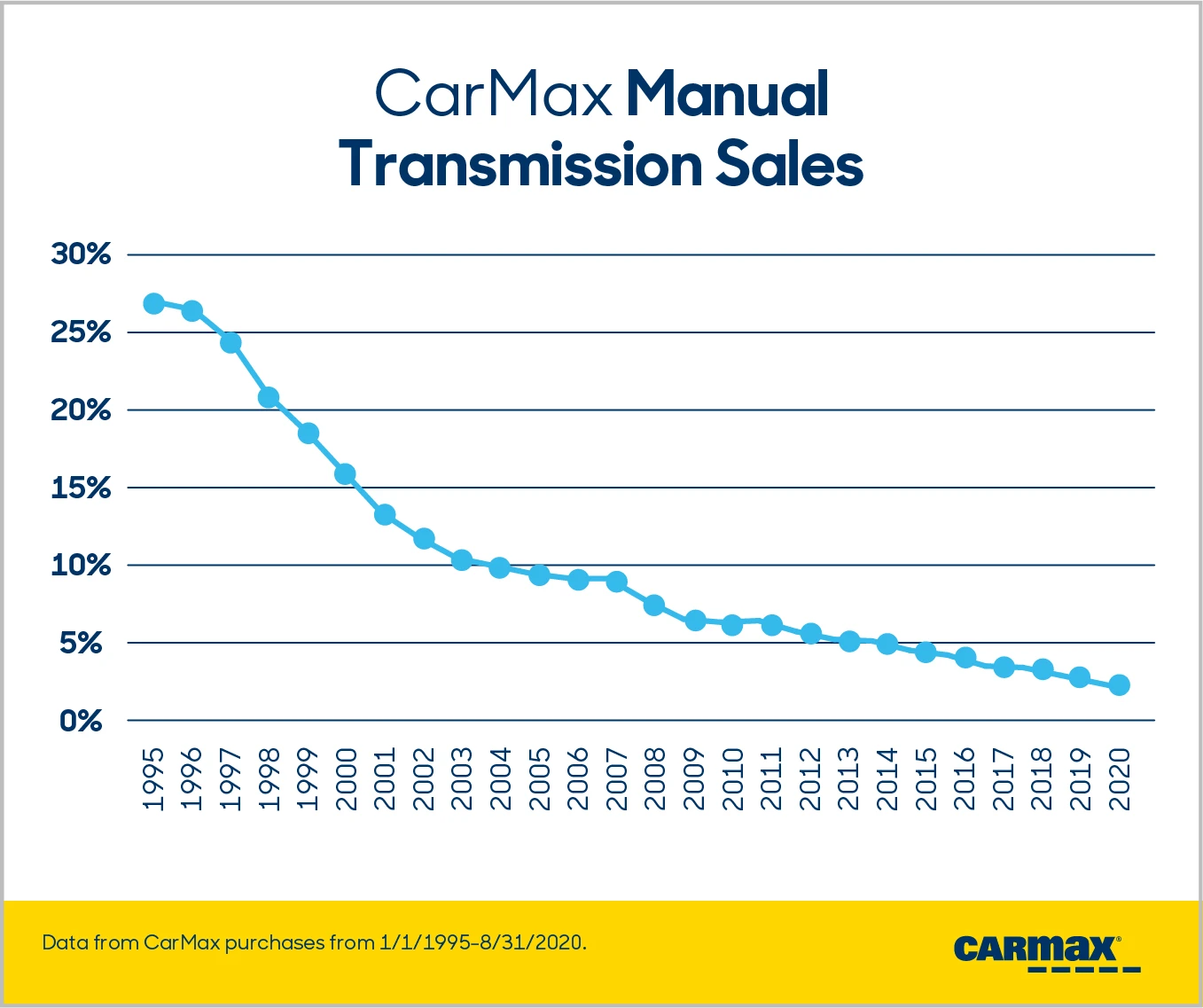
Yep, nice chart.
Now lets do “Percent of make/models where automatic is standard on the lowest trim level” (probably weighted by sales).
And, back it up to the 1950s. And, do charts for a couple dozen other features that are standard today.