Crikey!
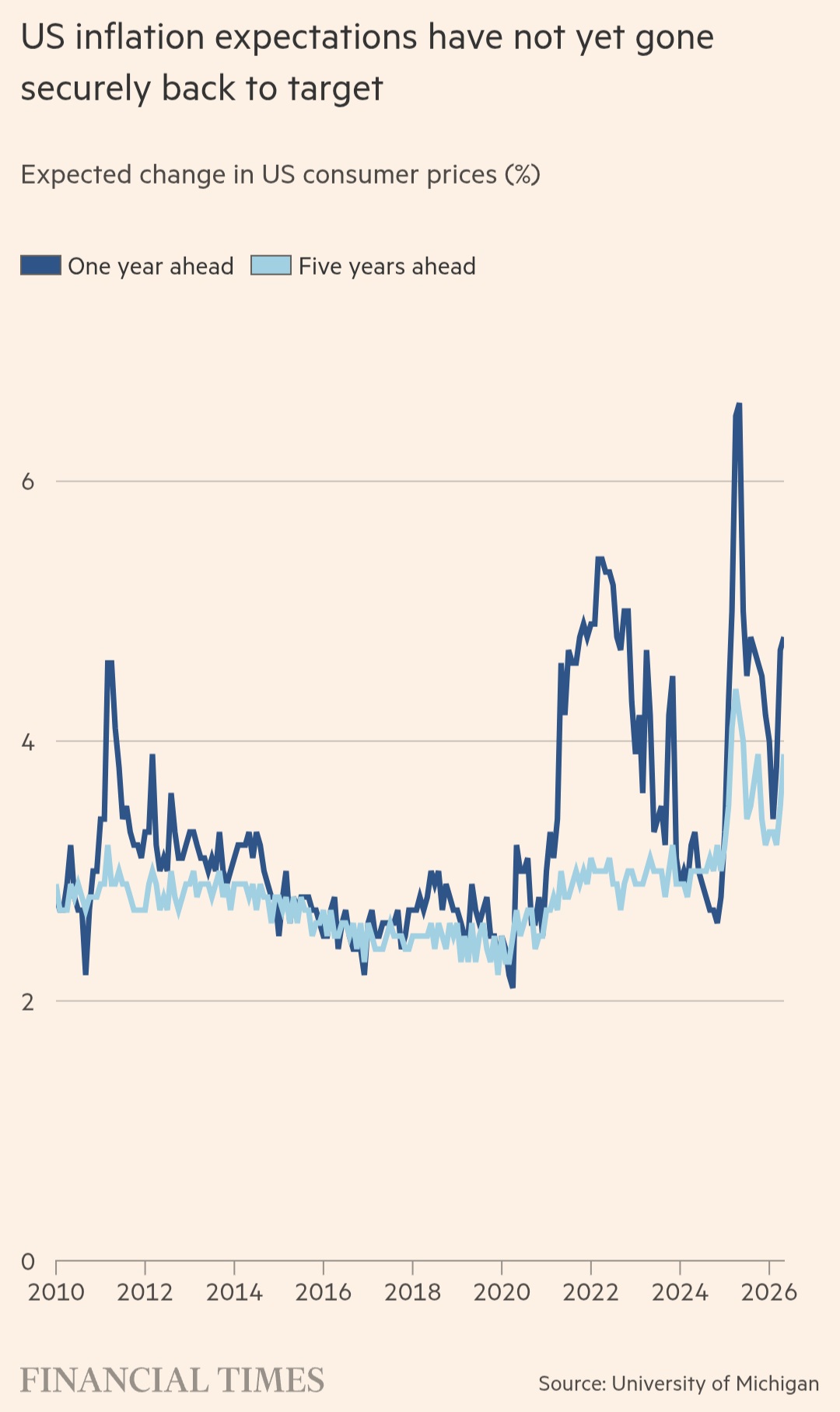
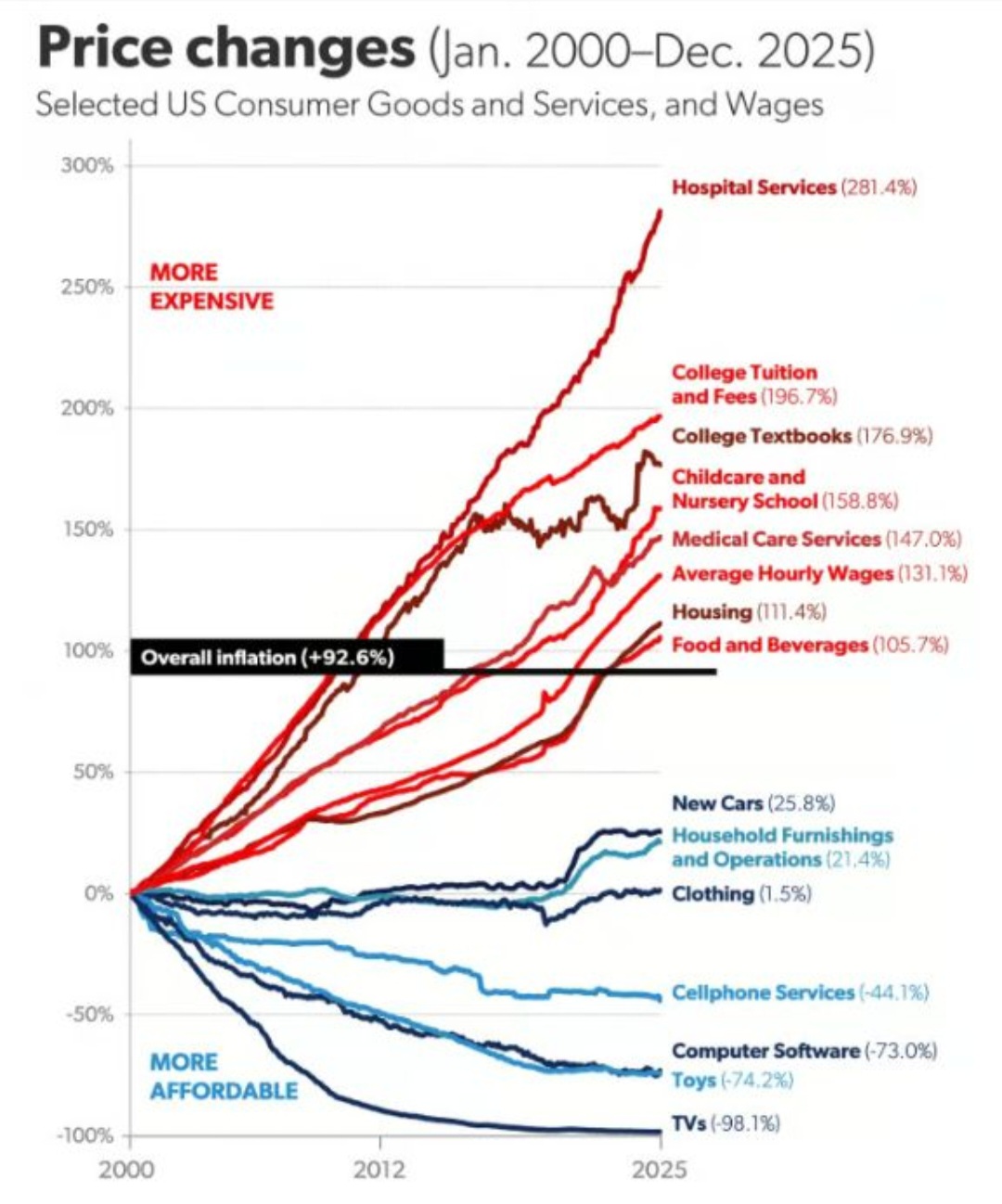
I track healthcare expenses pretty closely, particularly Medicare. Medicare costs went up almost 8% in 2024, and about 6.5% in 2025, data is sparse for 2026 but we are estimating 5.0% currently. A good chunk of the 2025 inflation was due to what was essentially (but not technically in most cases) fraud related to skin substitute products.
I’m told some of it is that it’s taken this long for hospitals to catch up on staffing from covid losses, plus some pent-up demand for elective procedures. Drug costs are also driving some of it, there are a lot of high-dollar drugs rolling out.
Western Europe spends about 11% of GDP (varies by country) on healthcare, the US is around 19% and will almost certainly hit 20% soon.
2 Likes
I wonder where they got their “average hourly wage”.
The median weekly full time wage went from $579 to $1,215 according to FRED. That is an increase of 110%.
The “cars” rate of +25% is pretty out of line with the numbers I get from the BEA. 2000 average car price was $20,356. The average 2025 price is $50,080, the first time it’s ever exceeded $50,000.
A lot of that is the fact that there simply aren’t many cars with MSRPs below $25k any more. The car market is all about big ole trucks and SUVs. But you can’t buy what isn’t for sale.
1 Like
I’m guessing that it’s like with like (which may not be that useful in this case). I presume there were a lot more sedans in 2000 and a 2026 sedan (if it exists) with similar features to the 2000 sedan may have only gone up 25%.
Interestingly, in other countries where EV adoption is high and where they don’t have crazy high tariffs on Chinese EVs, the price of cars is starting to come down. EVs have far less moving parts than ICE cars and at scale, are cheaper to make. They’re already cheaper than ICE vehicles in the UK.
I think that is a normal adjustment for inflation calcs. I don’t know how they handle cars getting larger over time, I would have to look it up but roughly speaking, a 2026 Honda Civic is larger than a 2000 Honda Accord, something like that.
Manufacturers build what they think they can sell at a profit.
There are some “compact” sedans that start around $25k, one sub-compact at $19k. The market has moved to SUVs. The cheapest starts at $25k. The one I drive has an MSRP of $32,500, but I see a $3,500 rebate.
I think a lot of the people who could spend $25k on a car would rather buy a used vehicle with more nice-to-have features than a new car that’s more basic.
The BLS adjusts their price trends to account for features, that’s most of the difference between the BLS number and the average selling price. https://www.bls.gov/cpi/quality-adjustment/new-vehicles.pdf
I think cars just have more and more stuff.
I speculate here,but..
It would be something that happens as a kind of chain reaction. The particular model(s) used in 2021 would most likely have direct baselines in 2020. The CPI for that year may change the precise basket of goods, but..“it’s close enough for government work”
Picture this happening repeatedly. After 15 years, the 2025 basket would look considerably different than the 2020 basket. Without a doubt, some items in the basket just get replaced..the old buggy whip story.
Note this different than how to compare an iPhone or a laptop computer over time. I believe there is a process that adjusts the “prices” in those situations.
Just my own, unconstrained imagination.
2 Likes
I like learning.
Do you have anything on what gets used in the CPI calc? The one that dictates other figures used in Federal statutes..like annual SS benefits or the Poverty line?
I’m not sure what you are asking. The link says:
These adjusted prices are used in the compilation of the following official BLS price indexes: the
Consumer Price Index (CPI), the Producer Price Index (PPI), and the U.S. Import and Export Price
Indexes (IPP).
That answers it. When the newer model comes out, they adjust.
Not clear what happens when the model is discontinued, at least in that doc.
I like the year on year idea as over longer periods of time, changes in areas such as technology can really mess with the calculations.
For example, memory storage used to be quite an expense. Back in 2003 I bought a 512MB SD card for my camera for around $130. Now you can buy 128GB for $31 (granted, far less people use SD cards now). That’s roughly one-thousandth of the price per MB (even less with inflation).
Recorded music is interesting. From memory, vinyl albums cost $AUD15 in the early 1980s (equivalent to $US40 today). When CDs came out a couple of years later, they were about 50% more than vinyl. It was quite common to have at least 100 albums collected over several years - so $5,000-10,000 worth. However, people generally stopped buying albums after a few years and tended to listen to the same albums for years after.
I used to think that recorded music was so much more expensive then. However, itt costs $120 or so a year for Spotify. Multiply that by 50 or 60 years of adulthood and the lifetime cost for recorded music is in the same ballpark as the vinyl/CD era. Of course, one may have more than one streaming service and buy music separately, so it could be quite a bit higher.
Yup.
One aspect that is worth noting. After 10 years of Spotify you own nothing. Zip. DeNada. And the subscription rate will only be going up from here, never down.
Those cds and vinyl actually have value. They are assets. You can trade them, sell them, whatever.
Going rate seems to be about $0.50 to $1.00 each for CDs.
Probably best to buy them used.
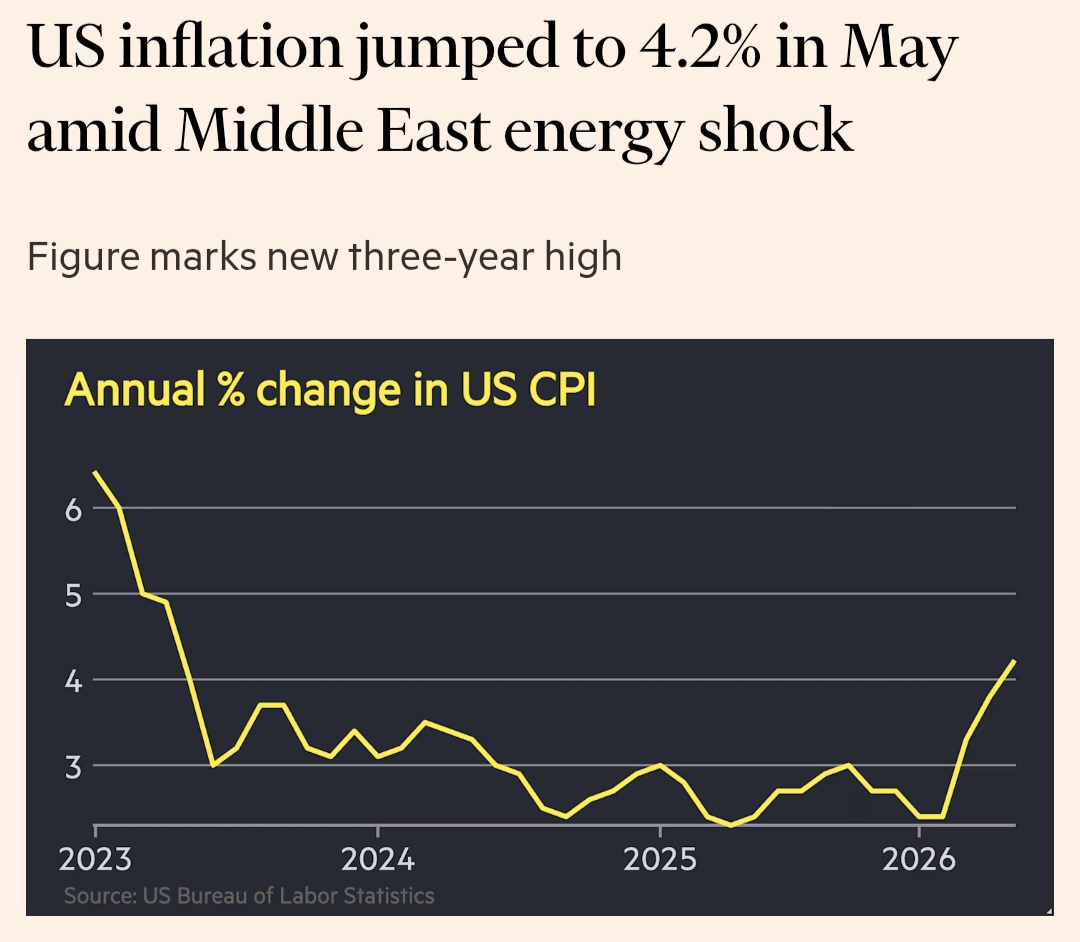
The WH puts a positive spin on the May numbers:
The White House said the newest inflation figures reinforces that “despite temporary disruptions as a result of Iran’s efforts to subvert the free flow of energy, President Trump’s broader economic agenda continues to deliver meaningful results for the American people”.
He could try to one-up Nixon and use the fourth derivative: “the rate of increase of inflation is increasing at a decreasing rate”
2 Likes