Can they make a smaller one?
No. Longer range requires more batteries, abd there’s no room for them in a smaller car.
Waiting for solid state.
Can they make a smaller one?
No. Longer range requires more batteries, abd there’s no room for them in a smaller car.
Waiting for solid state.
Same. House wiring aside, at this point I won’t consider full EV until solid state (that is hopefully sourced from not-China) becomes commercially viable at EV scale.
Bump, cuz auto-pilot gonna auto-pilot right through a closed RR crossing:
Huh, can’t find it online (CBS’s Facebook has it), but it is on their nightly news right now.
Now, is it legit? No idea.
OK, found it:
https://electrek.co/2026/04/15/tesla-fsd-railroad-gate-oncoming-train-texas-owner/
Now, it’s possible that the Tesla was sentient and suffering from a depression of some sort.
he was stopped at an active level crossing — arm down, lights flashing, a train visible in the distance — and settled in for what he assumed would be at least a minute’s wait.
Then, he says, the Tesla took off on its own.
“Without any warning… my Tesla suddenly accelerated forward on its own,”
Yikes! Sounds like a car from a Stephen King novel. From now on, every time he’s stopped at a train crossing, he should physically get out of the car until the train has passed.
Or, stop using FSD.
Take some frickin’ responsibility and drive the car yourself.
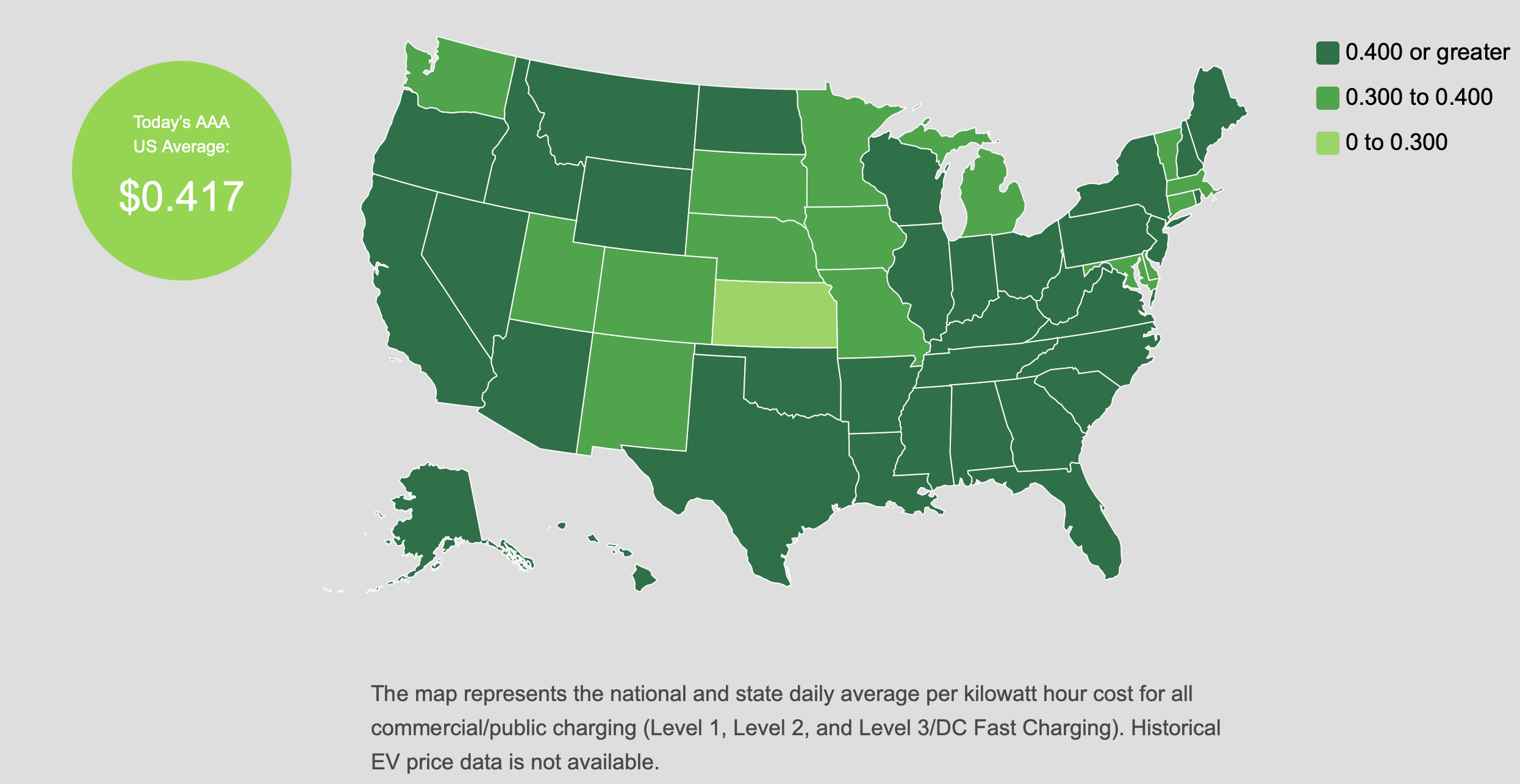
They really should break out DC fast charging separately from L1, lol. Where you charge… it matters a lot. All I know is if I charge overnight it’s about $0.07 per kWh including fees and taxes and whatever else.
Now, the problem in KS is lack of DC chargers. Sure, I70 has a lot, and highway 35 is pretty good. Outside of that it gets a little dicey.
What is the approximate breakeven rate with gasoline for public charging options?
Assume it needs to be one of the options that gets you >80% in <15 minutes?
One gal of gas has the energy equivalent of 33.7 kWh, so 1 gal of gas is $13.8 in fast charge costs. But electric cars are between 3 and 4 times more efficient than ICE, so maybe $4 gal gas equivalent.
And in terms of 15 min to 80%, that is vehicle and charger dependent. Not all cars can do that, and not all chargers can supply the power levels needed to cars that can accept it.
One aspect of owning a full EV I never thought of: Is it true that it costs more to insure an EV vs. a conventional or hybrid? If so, is it enough more to affect the scale of which type has the lower overall cost of ownership?
I have less expensive evs, a Nissan leaf and a Chevy equinox. I haven’t noticed a difference in insurance costs that don’t seem proportional to vehicle cost. But that’s just anecdotal. We have pros in that area on this board, I bet.
Comparing the VW ID4 with the close ICE equivalent Tiguan, the insurance is on average $500 more a year. The price of the car is $15K more (we got nearly $12K in rebates - no longer available) and fuel prices are about $1,400 cheaper per year for the EV (with our usage). Long term maintenance costs are supposed to be significantly cheaper for the EV but we’ve only it had it for 3 years.
Resale value for the 2 cars at 3 years old is roughly similar, so after 5 years one is probably taking a $10K hit (if no rebates and not taking into account maintenance costs). Assuming EVs are much cheaper to maintain, resale costs should improve as word gets out. Currently, used EVs are an excellent bargain.
Prices for EVs are coming down but tariffs have slowed down that trend in the US. Apparently EVs are already cheaper than ICE to buy in the UK.
Regarding charging times, it only becomes an issue if you have travel more than 250 miles in a single day. For a 500-700 mile day, it can add 30-60 minutes to your trip time. Again, China now has chargers that can get you 200 miles of charge in 6 minutes but tariffs are preventing us from getting anything like that technology here.
The bulk of refueling will be when you charge at home (assuming you have your own garage), which means no more trips to the gas station apart from the rare days when you are on road trips.
Edit: Forgot to say that we also got 3 years free fast charging through VW, which saved us another $4.5K
BMW has updated their range estimate for the upcoming iX3. Previously they just said about 400 miles, now they say 434, though still not an EPA certified number.
If you run it the 10-80% range, at highway speeds, in colder weather, still probably getting over 200 miles between charges. Seriously good.
https://insideevs.com/news/794380/2027-bmw-ix3-range-increase-us/
So the short answer is “yes but”? Is the overall cost of ownership less for EV than for regular yet in the US?
@quoll did a great job, so I’ll only add my anecdotal insurance story.
My 2015 Chevy Volt was about $50 or $55 per month. My 2023 Model Y Performance is $80 per month, and at the time I was also shopping a Civic Type R and it was nearly identical. I’m 47 with no accidents or tickets in forever. One claim for hail damage back in 2015 or so.
It will be higher.
Taking 5 year ownership for EVs vs ICE (using my above example) -
Upfront price $3000 per year ($15000 more for EV, amortized)
Insurance $500 (per year)
Fuel -$1,400
Maintenance -$330 (according to AAA, average EV vs ICE)
Resale -$660 (amortized, EV is worth $3300 more at 5 years according to Kelley Blue Book).
EV will cost you $1,110 per year more over the 5 years. This is based on average $4.00 per gallon price and current depreciation rates. I anticipate that there will be increasing demand for used EVs which would mean depreciation will not be as dramatic, if gas prices remain high for an extended period of time. This would make them closer to parity.
Hmmm. But perhaps it’s worth it to not depend on what gas prices are doing.
Thanks for the info! I’m not on the market at this time, but it’s a shift I’m considering in the future.
Too many conditions to answer as a yes/no.
Not having access to home charging tilts the scales toward ice.
Use case matters. Only need a car for daily commutes in city traffic? EVs do that inexpensively. Towing your 6000lb boat 200 miles several times a year? Not as much.
If I was in the market right now I think there’s excellent value in a used 2025 or 2024 EV. I could be wrong, but I don’t even think the mileage is that important (compared to ICE cars). It might be best value to get a high-mileage used 2025 or 2024 as the prices are considerably lower.
That is the most important factor really.
Being able to use the cheaper overnight rates at home makes it much cheaper to run (which then offsets the more expensive insurance rates).