Sounds like github.
I assume CS is doing some expert trolling.
The sad truth that what we want is a robomaid to launder our underwear and dig our potatoes, leaving us plenty of time to do the real work like science and art.
Instead, what we are building is the uploaded hive mind of Stephen Hawking, to do all the real work. Leaving us with plenty of free time to launder our underwear and dig our potatoes.
3 Likes
For an SME, I agree.
AI allows you to put on many hats. You can do the work of multiple people now faster and cheaper. What took weeks and cost $$$, can be done in days and costs $. Your productivity goes up.
But for a large multinational, its not quite so clearcut due to the regulatory nature of insurance work.
AI can cut down admin work, and replace established things like automated under-writing and reports, as well as valuations and reports.
But for more complex work…nobody really trusts the output.
You also have nobody to actually talk to about how the AI model produced those outputs (this is actually a big deal for a lot of people). People trust face to face explanations more from a human subject matter expert than they do the reasoning behind AI outputs (this also assumes you have full access to them so you can trace the workings).
I’m sure I’ve asked these questions before, but I can’t help thinking them anyway.
“When are you planning to lower colonelsmoothie’s price to reflect your efficiency?”
And “If many businesses all become more efficient, so competition drives prices down, what happens to the many workers they don’t need?”
Already built in. His current prices reflect current and future expected discounts.
Good question, not that I’m an expert. But my theory is:
SME’s get a huge leap forward. Folks like me basicaly have access to a team of coders, some MBA’s and marketing experts. It’s a whole team that we couldn’t afford before, as much as we need to lean on them. So, there’s going to be some barriers broken there, where small businesses just start doing stuff they simply couldn’t before. That’s 100% me.
Larger companies are going to do two things I think. One is, slash staff. If a single person with Ai can do the work of 5, then they can get rid of four people. I think that’s going on.
Or, they lay off say 25% and train the rest on how to use AI efficiently and properly. And now they’re getting 10X the work done and take a leap forward in their products and services, and they do it so fast it’s hard to keep up.
I think a lot of larger companies are doing the first. My buddy is leaning more towards the second, I don’t think he’s done any layoffs but I wouldn’t want to be working for him and not leaning hard into AI because one of the things he’s got AI doing is measuring productivity in a bunch of different ways - and inefficiencies are being found. I think he’s going to keep most people on staff, and just accelerate their progress to the moon.
I’m not sure how to read this. Are you saying that you are charging your customers less because you expect future savings? Or are you saying that some other businesses are charging customers less because they are expecting future savings?
I get that SMEs see an opportunity to compete with bigger companies. That means they can capture more market share. But, the market doesn’t get bigger.
Big companies use AI to cut costs and/or to take a leap forward in their products and services, and they do it so fast it’s hard to keep up.
The hope is that all the companies that save money with AI are forced by competition to pass the savings along to their customers. Then consumers use their savings to buy the new products they didn’t know they wanted before AI came along. These new products still require some humans, so the people laid off due to AI get hired for the new products. Somehow AI companies get enough revenue out of this to make a profit on their huge hardware investments.
We’ve seen this happen in the past, but it takes time for all these dislocations to work themselves out. With AI, the claims are that it is huge and coming fast. It seems like there has to be a period when lots of people feel they are worse off.
I’m saying colonel smoothie is paying $0 for my services and that trend will continue :).
the rest, what do I know? Nothing. I do know that the impact on what I do for a living is huge, I can’t get all the stuff I want to get done, done fast enough. And for those that aren’t already onboard, it’s going to get dicey soon. Stuff is changing rapidly, perhaps more than people realize, and the impacts haven’t really been felt yet. What those changes are, I dunno.
1 Like
When precision is required…AI does not do well.
Financial technology firm Saturn tested 18 popular AI models against 121 different financial questions, putting more than 10,000 questions to the models altogether. In the models’ answers, Saturn found that calculations contained errors, risk warnings were missed, upcoming tax changes were ignored and non-existent rules were hallucinated.
Models such as ChatGPT and Claude gave out inaccurate financial advice 57% of the time, with the errors potentially costing tens of thousands of pounds; one mistake would have triggered a £17,500 loss. Some models gave incorrect advice 99% of the time in response to more complex personal finance questions.
The worst-performing model was Anthropic’s Claude Haiku 4.5, which made mistakes in 82% of answers. The second worst was Google’s Gemini 3.1 Pro, failing 73% of tests. xAI’s Grok 4.5 made mistakes 59% of the time, followed by OpenAI’s ChatGPT 5.6 Luna, with 58%.
Asked more complex financial questions, Google’s Gemini 3.5 Flash and Anthropic’s Claude Haiku 4.5 gave wrong answers 99% of the time. The best performing model overall was Anthropic’s Claude Opus 5, which nonetheless made mistakes in 39% of its answers.
https://www.theactuary.com/2026/09/22/most-ai-financial-advice-found-contain-errors
well as I’m starting to say more often, I worry about what AI does well, and quit worrying about stuff it doesn’t do well. There’s a million examples of things it currently does poorly. And quite a few of things it does exceedingly well. I’m hammering away at stuff it does really well, like coding, analysis of complex numbers and finding errors, stuff like that. My ad campaigns occassionally go offside, cost me a lot of money and it’s troublesome to find the cause. AI pinpoints problems within 3 minutes.I write large complex coding projects with AI, at no cost and in like 1/50th fo the time it’d take to do it without AI. etc.
2 Likes
If it’s stupid and it works…
hey that’s me!
2 Likes
I am curious about whether you think you are overbuilding. You talk about getting tons done at a furious rate but still aren’t done. Not trying to be critical, but I have so little experience with the systems you are talking about that I have trouble imagining a 6 mo project level of detail.
Well I just installed a couple servers with an AI card into a colo. Then I moved our internal file server, a bunch of complex websites, this website which was surprisingly complex, my large crm with a bunch of ai coding, from all over the place to the servers. Lots of hardware and setup decisions in there as well. Then archives and backups, and setting up a backup server off-site. Then monitoring of absolutely every last little bit of that so I get triggered if there’s any misses anywhere. And lots of cleanup during that process. Where I’m at now with my systems, never in almost 30 years have I had this level of control and stability in my systems.
This week I’m building our an AI playbook for every aspect of my business. Top level, 5 year business and strategy conversations. Below that, all the info about my systems and websites, my seo, my various advertising venues, etc. so when I use it for stuff, it’s got access to all the info it needs, about everything.
None of that is outwardly a big deal. But internally it’s going to let me build out me seo, my ads, expand my ads, make more sales, build out websites that sell without me interacting, and scale. None of which I could really do before. It’s giving me the ability to create a startup instead of a lifestyle business.All without funding that startups normally need.
So nothing to see yet, but the framework im building is awesome Inspiring to me.
I’m this close to starting to go. Next week I put in place a playbook to optimize my ads, allowing me to ramp up my advertising spend, and more sales as a result. I’ll also be building out a 3-5 year plan, starting with the ad optimization, moving on to seo, building some automated sales websites, etc. almost there.
2 Likes
I doubt AI is great at financial advice, especially if it gets into complicated details or numerous spreadsheet calculations. At the same time this looks like shit science.
The list of “errors” include some things that I would consider subjective and context dependent. They give a few examples of bad looking errors, but those all come from the worst model. Which at least makes me wonder if the better models made no real errors.
Also the answers they do show are suspiciously short (did they prompt it to answer in a short sentence?) and they don’t address follow-up questions that the LLM asks the user. So are they marking everything as incomplete when the LLM is asking for context? They use an LLM grader, and it’s unclear if/how they validated it. Finally, there’s no human baseline, which would tell us if there’s a big problem with the methodology, and whether AI performed better or worse than a human.
Additionally it’s produced by someone obviously trying to sell their improved AI solution.
I think realistically the only conclusion you can take is be careful about using Claude Haiku 4.5 for financial advice, but that’s not very useful because even for free Claude defaults to a better model.
1 Like
Undecrypted Enigma messages from WW2 have been decrypted.
There will be abundance…just not of the type that you think.
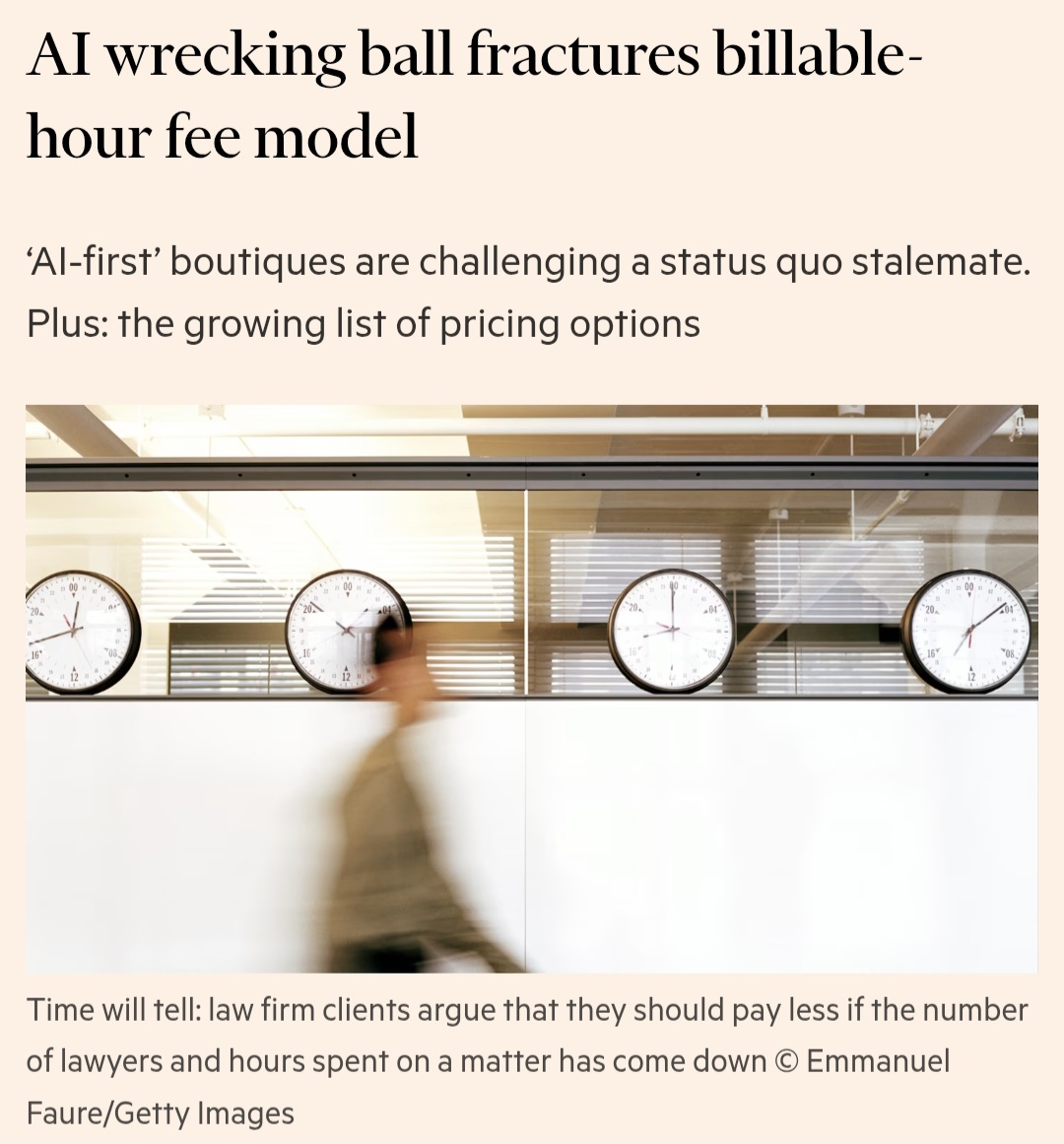
A number of Wall Street banks, among the most important clients of large law firms, are pushing their legal advisers to cut fees, arguing that the business model that has enriched top lawyers for decades is not sustainable in an era of AI.
Goldman Sachs, Morgan Stanley and Citigroup are all expecting their legal advisers to pass on cost savings from the technology, sources told the FT this month. The equation is simple — if the number of lawyers and hours being spent on a matter has come down because of AI use, clients should pay less.
I wonder what the impact of LexisNexus and similar search engines was relative to the older model of manually looking up case law in physical libraries. I would expect LLMs to be the continued evolution of that kind of information retrieval.
1 Like