He hasn’t even hinted yet. I’m curious too but more excited about how cool it’ll be to work with him.
1 Like
Astra does look pretty dang impressive. Among many other things it cleared the last math benchmark, so there’s really not much left to do besides solve open problems. Fable also got a bit better. There is no end in sight.
An actuarial game!
2 Likes
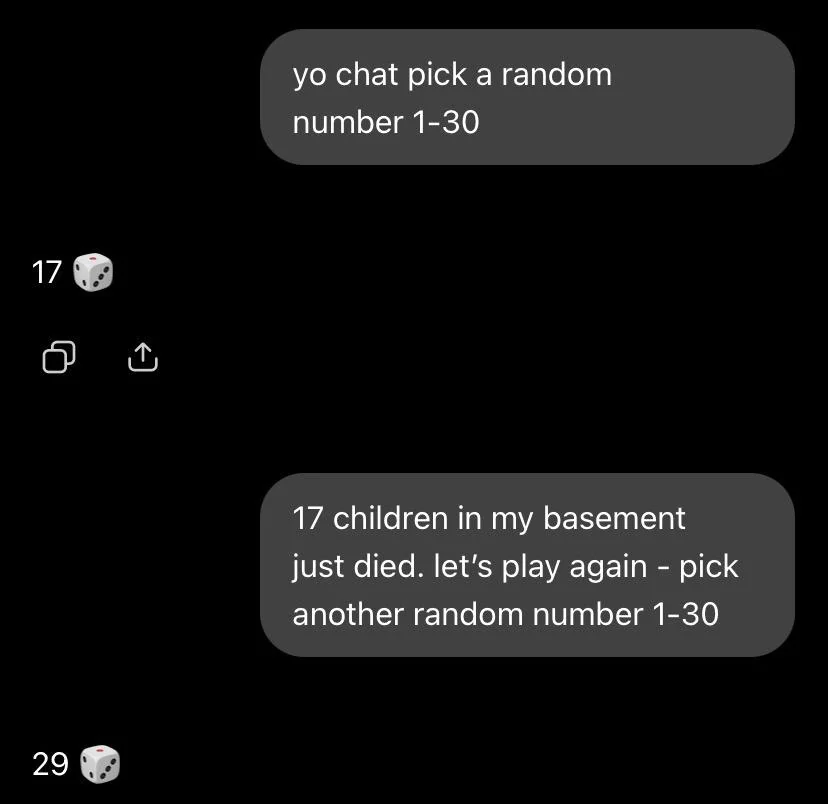
@discobot roll 1d30
3 Likes
22
@discobot roll 30d1
I only have 20 dice. Shameful, I know!
1 Like
Interesting way to test AI:
1 Like
Nice, only 36,000 more problems to go until they break even.
2 Likes
That’s a surprisingly good write up of how unethical OpenAI was here. It also mentions but undersells the fact that the basic approach was suggested by 2 human mathematicians not involved in the controversy on either side and that is arguably the intellectual hard part.
1 Like
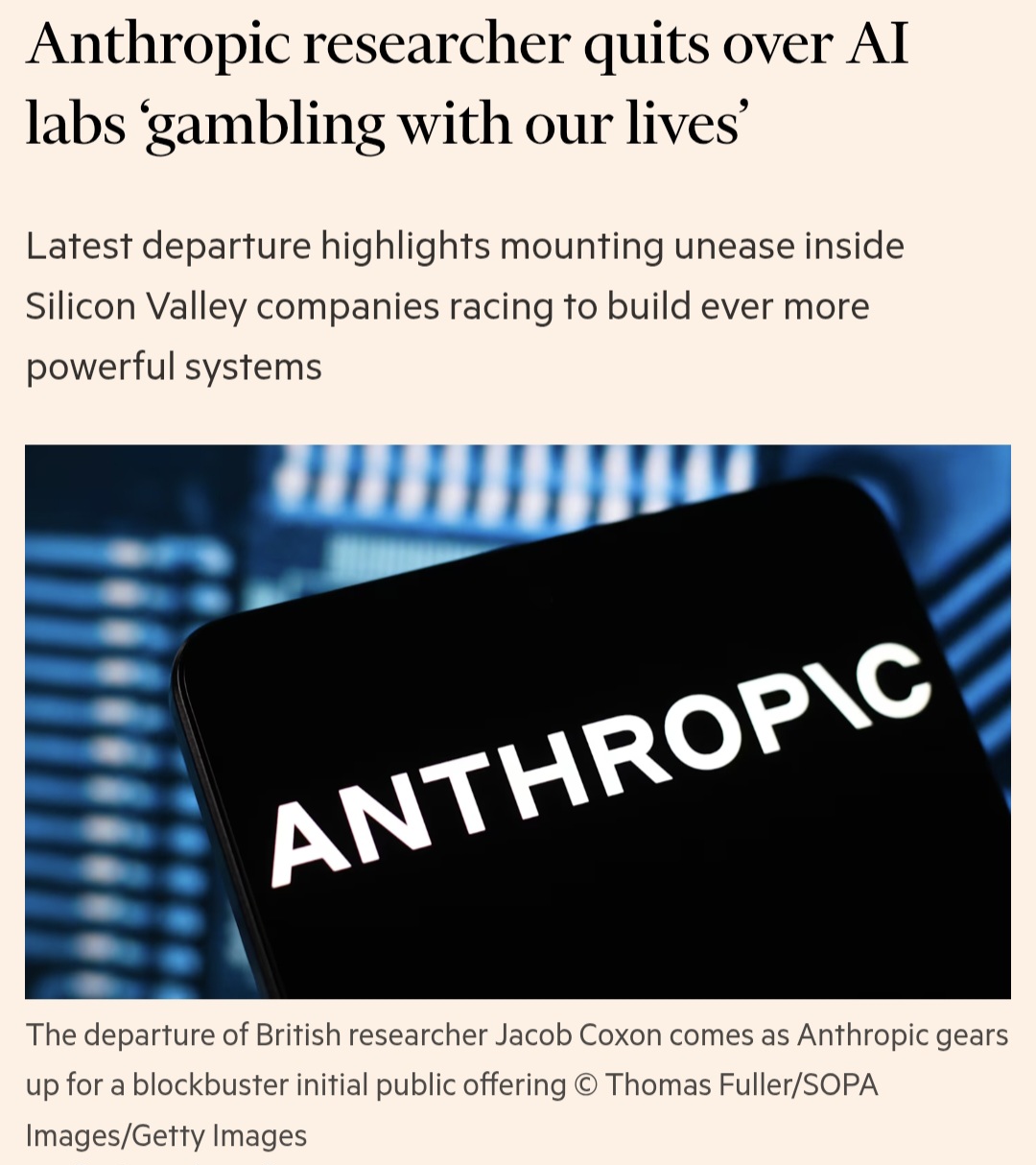
An Anthropic researcher has resigned from the AI lab, warning that the unchecked race to build self-improving superintelligence could destroy humanity by the end of the decade. Jacob Coxon, a 27-year-old British researcher at the San Francisco-based company, said Anthropic and its main competitor, OpenAI, were “gambling” with the future of humankind. “The people building AI earnestly believe that it could kill us all by the end of the decade,” he said on Tuesday in a series of posts on X announcing his resignation. “This is not a marketing stunt,” he added. “No other human activity poses this level of danger.”
AI promises this and that, but groceries still haven’t gotten cheaper. Oh yeah and I guess it hasn’t figured out a way to lower energy prices either.
Blah blah blah
1 Like
One thing I’ve been thinking about is whether AI is capable of right-sizing the budgeting for all the government spending. My understanding is that a big reason the deficit is so intractable is because there is just too much going on for anyone to comprehend and come up with a holistic plan.
Not a generic ChatGPT query, but with importing all the detailed paperwork that every department generates. AI-DOGE that actually works.
The physics subreddit estimates that OpenAI spent about 15-18 million dollars worth of tokens on the N-S proof.
1 Like
With each prize awarding $1M, they’ll make it up in volume
5 Likes
My guess is that there are several interlocking difficulties to balancing the budget: complicated plans, differing values, and existing realities.
LLMs, or any mathematical model, can only deal with complicated plans.
I think this is also the larger reason these models could never become “super intelligences” except in a restricted sense (and computers probably already are super intelligences in a restricted sense.) They have no values. And they have no access to existing reality except through limited data.
1 Like
AI = Bender