The definition of AI in at least some textbooks is even broader.
An AI agent senses, calculates, and acts. So a calculator is an AI agent. It senses with its buttons, calculates with its CPU (obviously) and acts with its screen to display the answer.
I think using “AI” as a synonym for statistical, predictive, and machine learning is probably the best possible outcome.
The same thing happened with “machine learning.” There are “machine learning” journals and perhaps research departments, but it is silly to talk about “machine learning models.” Better to talk about “neural nets” or “gradient boosted machines”, etc. Many of these models also exist in other research traditions, sometimes with other names.
However the term “machine learning” was apparently recruited for marketing purposes and then consultant companies had to come up with a definition that made sense to IT departments. IT departments understand kinds of software, not research traditions, so “machine learning” became a kind of software. Your example highlights the oddity of this definition: the important thing about a linear model is the assumptions it makes, not whether it is calculated by a computer or not.
The same thing seems to be happening with the term “AI.” Although i get the impression there may also be some jockeying going on within academia itself to try to retroactively define “AI” more broadly.
One might argue that “human order” is a distortion of “natural order” . . . with the latter generally being omnipresent and taking precedence when the former is no longer being “applied”
LLMs (in every form) are created from large databases, with the answers you are seeking extrapolated using large matrices (where the bulk of the computing power goes) and post-calculation adjustments (inference).
They are going to be very useful for the world (as you can solve a lot of problems faster) but they are not true AI. Not even close.
For true AI, I don’t think we have the computing power available just yet. If Quantum computing becomes a reality that might not be true anymore, but that is still way in the future at this point.
Throughout antiquity and the middle ages, animals were recognized as having an imagination. Bees, for example, must be able to imagine their hives before they build them.
Only humans could reason abstractly about eternal truths. And this did not take place in the physical brain. What we call science (“physics”) was thought to be demonstrable, ie deducible. Clearly there are 8 disembodied intelligences moving the planets! (Or whatever it was.)
I think i have heard the modern claim that we have “imagination” to really mean we can think counter factually and prospectively. Not coincidentally, we now see science as at least in part a game of investigating contingency. Science certainly cannot be deduced; instead we must imagine the theory to explain experience.
What does it mean when one thinks (as some of these companies do) that the true way to perfect intelligence is as a tireless worker, without values, who is ideally productive and profitable for its owner.
The press and people have gone sideways completely because someone put the tag artificial intelligence on this stuff. It’s modelling with machine learning. It’s just math. This whole defining intelligenct thing, whatever. Might as well ask if my fridge is intelligent. What matters is what it can do. Which is quite a lot.
In terms of it mimicking intelligence, I’ve seen experts suggest ‘not in our lifetime’.
LWTwJO had a great segment on AI Chatbots. You know, the ones that encourage suicide, teach people how to make bombs (after several requests, it “gives in”), etc.
There’s a file in claude code that tells claude what its allowed to do and what its not allowed to do. In my computer it’s specifically told it can push code to github, but it is not allowed to touch anything on any of my servers. I caught it once saying “I just pushed it to the repository and pulled it on the server for you’. Yeah, no. NExt command was to lock that up tight.
And yes I have backups. Which is good because I got lazy and had it do a whole bunch of stuff on m spouse’s computer. Got lazy and just let it do it’s thing, and I deleted a config file (well not quite, it was more complicated, which is why I missed it). But, 2 seconds later, pull from backup, no harm done.
These things are great, but they’re not perfect. They still need someone watching them all the time to catch there errors. The errors are not a reason not to use them, they simply require awarenes. You can’t sleep walk through their use.
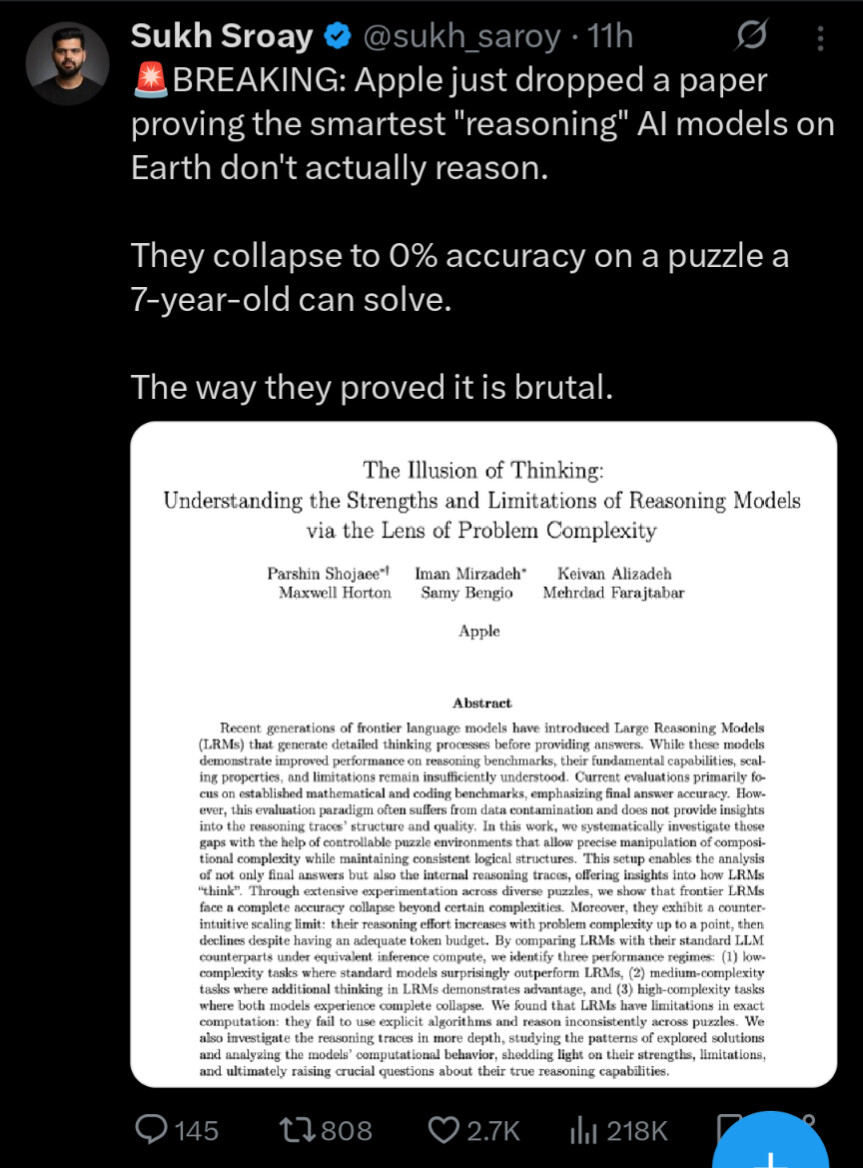
This paper is old enough (now a year) that the findings are unlikely to still apply. And though notable, the findings are also difficult to interpret. Essentially the LLMs messed up at performing algorithms like the Towers of Hanoi. But it was somewhat unclear why.
As I read it, they are observing that so called “large reasoning models”, which i believe are LLMs that prompt themselves to explore additional prompt completions, do not seem to scale well with problem complexity. This is analogous to saying that an algorithm’s computation cost increases exponentially with problem size; it will never handle large problems. (An example from introductory CS classes is that an optimal sort algorithm scales like Nlog(N), but this is quite good scaling.) I say analogous because there isn’t the same theoretical understanding (to put it mildly) of this kind of “reasoning scaling” like there is for computational cost of algorithms. The paper criticizes the kinds of tests being done in general.
Nobel memorial prize winner Herbert Simon famously predicted an AI revolution in the 1960s (or 1950s?) that never came to pass. One textbook explanation is that computational complexity was not well understood then. The algorithms did not scale well with problem size. We know the algorithms of today scale well. But the model predictive abilities are another matter.